Speaking online from Singapore and Malaysia
Most English-language guidance on online speech assumes a US or European legal frame. Singapore and Malaysia each have a distinctive set of speech laws, paired with deeply integrated real-name identity, and this combination maps onto neither frame. This page is for people in or from the two countries, and the wider Sinophone diaspora, who post — or repost, or comment — on sensitive topics (politics, race, religion, royalty, labor, LGBTQ) and want to reduce both legal exposure and the chance of being personally identified.
It is a regional companion, not a full playbook: the general operational security lives in how to build a threat model, activists and protest digital safety, and journalists and source protection, and this page adds the Singapore–Malaysia layer that those pages assume you already have.
In-region verification wanted before this page is treated as settled
We follow Singapore and Malaysia through public sources and diaspora contacts, not first-hand local practice, and these laws move fast. Read the descriptions below as a map of where to look, current at the time of writing, and not as legal advice. Before anyone relies on this page, a Singapore or Malaysia partner should confirm the current position on:
- Singapore — POFMA's present enforcement posture (correction notice vs. criminal charge), the FICA "politically significant person" designation thresholds, how far the Public Order Act reaches online organizing, and current SIM-registration and Singpass specifics.
- Malaysia — the post-February-2025 wording and penalties of CMA Section 233 and how the 2026 Heidy Quah intent test works in practice, the current pace of Sedition Act enforcement, the Societies Act threshold for what counts as "organizing," the scope of state-level Syariah enforcement, and current SIM / MyDigital ID requirements.
If you organize, give, or work on digital rights in either jurisdiction and can help verify or co-author, reach us through the Community page.
Why the regional frame is load-bearing
The same post that is unremarkable elsewhere can carry legal risk under a specific, named statute in Singapore or Malaysia, and the identity layer makes "just use a pseudonym" harder than it sounds. Two things drive this, and a third scales it:
- Content-specific speech law: Both states have statutes that reach online speech directly, some colonial-era and some recent, and enforcement clusters around a few sensitive themes rather than being uniform.
- A real-name substrate: National digital identity (Singpass in Singapore, MyKad and MyDigital ID in Malaysia) and mandatory SIM registration in both mean the account, the device, and the payment often already resolve to a legal name.
- Visibility and organizing scale the risk: A low-reach post, a viral post, and a coordinated campaign sit at different risk tiers. Most enforcement documented below lands on public figures, activists, and organizers, or on posts that travel; an ordinary low-visibility post is less likely to be acted on, though "less likely" is not "safe," and the 2026 trend is toward more prosecution, not less.
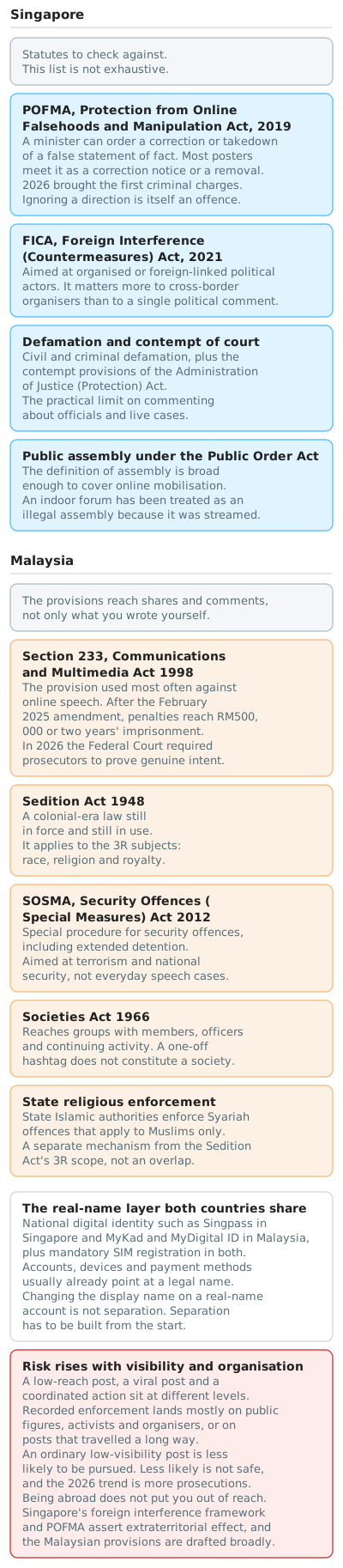
The legal landscape in Singapore
Treat this as the set of laws to check against, not an exhaustive list:
- POFMA (Protection from Online Falsehoods and Manipulation Act, 2019): Lets ministers issue correction or takedown directions against online "false statements of fact" deemed against the public interest. For most posters the first effect is a correction notice or removal rather than prosecution, but that is no longer the whole picture: in 2026 Singapore brought its first criminal charges under the Act, both for communicating a false statement and for defying a correction direction.1 Ignoring a direction is itself an offence, so the escalation path is real.
- FICA (Foreign Interference (Countermeasures) Act, 2021): Grants powers over online political content with foreign links, and designations for "politically significant persons." In practice these designations target organized or foreign-linked political actors, not the ordinary individual poster, so read FICA as a reason for cross-border organizers to be careful rather than a threat to a single political comment.
- Defamation and contempt: Civil and criminal defamation, plus the Administration of Justice (Protection) Act on contempt of court, are live constraints on commentary about officials and ongoing cases.
- Public assembly: The Public Order Act defines assembly broadly and can reach online organizing; a live-streamed indoor forum has been treated as an illegal assembly.
The legal landscape in Malaysia
- Communications and Multimedia Act 1998, Section 233: The most frequently used provision against online speech. Since the February 2025 amendment it covers content that is "obscene, indecent, false, menacing or grossly offensive in character with intent to annoy, abuse, threaten or harass," and the penalty ceiling rose sharply, to a fine up to RM500,000 or up to two years' imprisonment (higher where a minor is involved).2 Two qualifiers matter: it reaches reposts and comments, not only original posts; but a 2026 Federal Court decision requires prosecutors to prove real intent to annoy, so the statute's wide wording does not mean any post is automatically an offence.3
- Sedition Act 1948: A colonial-era law still in force and still actively enforced, applied to speech touching the "3R" sensitivities (race, religion, royalty); social-media posts about royalty have drawn charges and convictions as recently as 2026.4
- SOSMA (Security Offences (Special Measures) Act 2012): Provides special procedures, including extended detention, for security offences. It sits at the serious end (terrorism and national-security offences), not everyday speech cases; treat it as the ceiling of the risk spectrum, rarely reached by an ordinary poster.
- Societies Act 1966: Coordinated organizing as a group can require registration, and an unregistered society carries its own exposure. A one-off hashtag is not a society; a standing organization with members, officers, and activities is the kind of thing that can. If speech becomes organizing, re-read the activists scenario.
- State-level religious enforcement: Separately from the laws above, each state's Islamic religious authorities enforce Syariah offences that apply only to Muslims (for example content deemed insulting to Islam). This is a distinct mechanism from the Sedition Act's 3R scope; do not assume the two overlap.
What this means for you
- Assume the account can be tied to you: On the real-name substrate above, an ordinary account, phone number, or payment often already resolves to a legal name, so a display-name pseudonym on a real-name account is not separation. If you need to speak without that link, it has to be built in from the start.
- Know which theme you are touching, and how visible you are: Risk concentrates around a few themes (in Malaysia, the 3R; in Singapore, false-statement, foreign-interference, and contempt categories) and rises with reach and organization. Knowing which theme a post touches, and how far it is likely to travel, tells you which law is in play and how exposed you are.
- Reposting and commenting count: The Malaysian provision in particular reaches shares and comments, not just things you wrote, so "I only forwarded it" is not the shield it feels like.
- The diaspora is not automatically out of reach: Singapore's foreign-interference framing and POFMA's stated extraterritorial reach, and the general breadth of the Malaysian provisions, mean cross-border political speech deserves its own threat-model pass. If you still travel back, the bigger lever is your device at the border; if you have settled abroad and will not return, the practical exposure is more often account-level (takedowns, blocked access, pressure through local contacts) than personal prosecution, but the reach of these laws across borders is itself still being litigated.
Practical layer
Start from how to build a threat model: name who you are trying to stay out of view of (the state, an employer, family, a harasser) and what they can already see. Then, concretely:
- The honest limit of anonymity here: Because SIM registration is mandatory in both countries (in Malaysia now tied to biometric MyDigital ID verification) and Singpass or MyKad underpins so many services, getting a phone number and payment path that genuinely resolve to no one is hard, and a determined state actor with legal process can often still de-anonymize. Treat the realistic goal as compartmentalization and reduced linkage, not perfect anonymity: keep a speech identity on a separate email, browser profile, and device that never touch your legal-name accounts; never cross-post or log in across the two; and do not tie the speech account to your primary number or Singpass/MyKad-linked services. Where the risk is high and true unlinkability is not achievable, the larger lever is often what you say and how far it travels, not the handle you say it under.
- Pick messaging for the metadata, not just encryption: Which app ties to your phone number, and which does not, matters more here than the encryption alone. See secure messaging compared.
- Plan for device search at a border: Cross-border travel is a common exposure point for the diaspora; prepare the device before you travel. See cross-border travel and device searches in Asia.
- Route to the specific scenario: If your situation is LGBTQ-specific, the LGBTQ+ scenario covers Singapore and Malaysia in detail; for source protection, see journalists.
Where to go from here
- What an ordinary person should actually do — the shared baseline underneath every scenario, which this page assumes you already have
- Posting on mainland Chinese platforms — the same question under the mainland's real-name and filtering regime, which works differently from the speech-law model described here
- Regional observatory: what is actually reachable, and where, in the region.
- Activists and protest digital safety: when speech turns into coordinated organizing.
- LGBTQ+ across the Sinophone region: the Singapore and Malaysia detail for LGBTQ-specific situations.
- Secure messaging compared: choosing a channel by what it ties to your identity.
-
Singapore brought its first criminal charge for communicating a false statement of fact under POFMA in March 2026, and its first charge for defying a correction direction in April 2026. See Singapore: Drop All Criminal Charges Against Government Critic (Human Rights Watch, 25 March 2026) and Singapore activist Kokila Annamalai charged under POFMA (The Online Citizen, 23 April 2026). ↩
-
The Communications and Multimedia (Amendment) Act 2025 came into force on 11 February 2025, changing "offensive" to "grossly offensive" in Section 233(1)(a) and raising the penalty to a fine up to RM500,000 or up to two years' imprisonment. See Amendments to the Communications and Multimedia Act 1998 Come into Force on 11 February 2025 (Skrine). ↩
-
In Government of Malaysia v Heidy Quah Gaik Li (Federal Court, 6 February 2026), the court upheld the constitutionality of the "offensive" and "annoy" wording but required proof of genuine intent, finding the prosecution of Quah's Facebook post unjustified. See the Article 19 press summary. ↩
-
For example, the activist Chegubard was charged in June 2026 over a social-media post concerning Negeri Sembilan royalty and fined in July 2026 over another. See Malay Mail, 25 June 2026. ↩