The Tor Project's retrospective on the first year of Tor VPN Beta contains one finding that reframes the whole product. The team expected to learn from real-world use, and what they learned was that the primary use case is unblocking the internet — not the privacy features a commercial VPN would lead with. Early adoption concentrated in heavily censored regions, and that shaped what got built next.
That finding is the interesting part for us, a community based in Taiwan, because the regions we cover sit at very different points on that spectrum. This post checks the announcement against measurement data for seven Asia-Pacific regions, and sets out what the regulatory picture looks like in each.
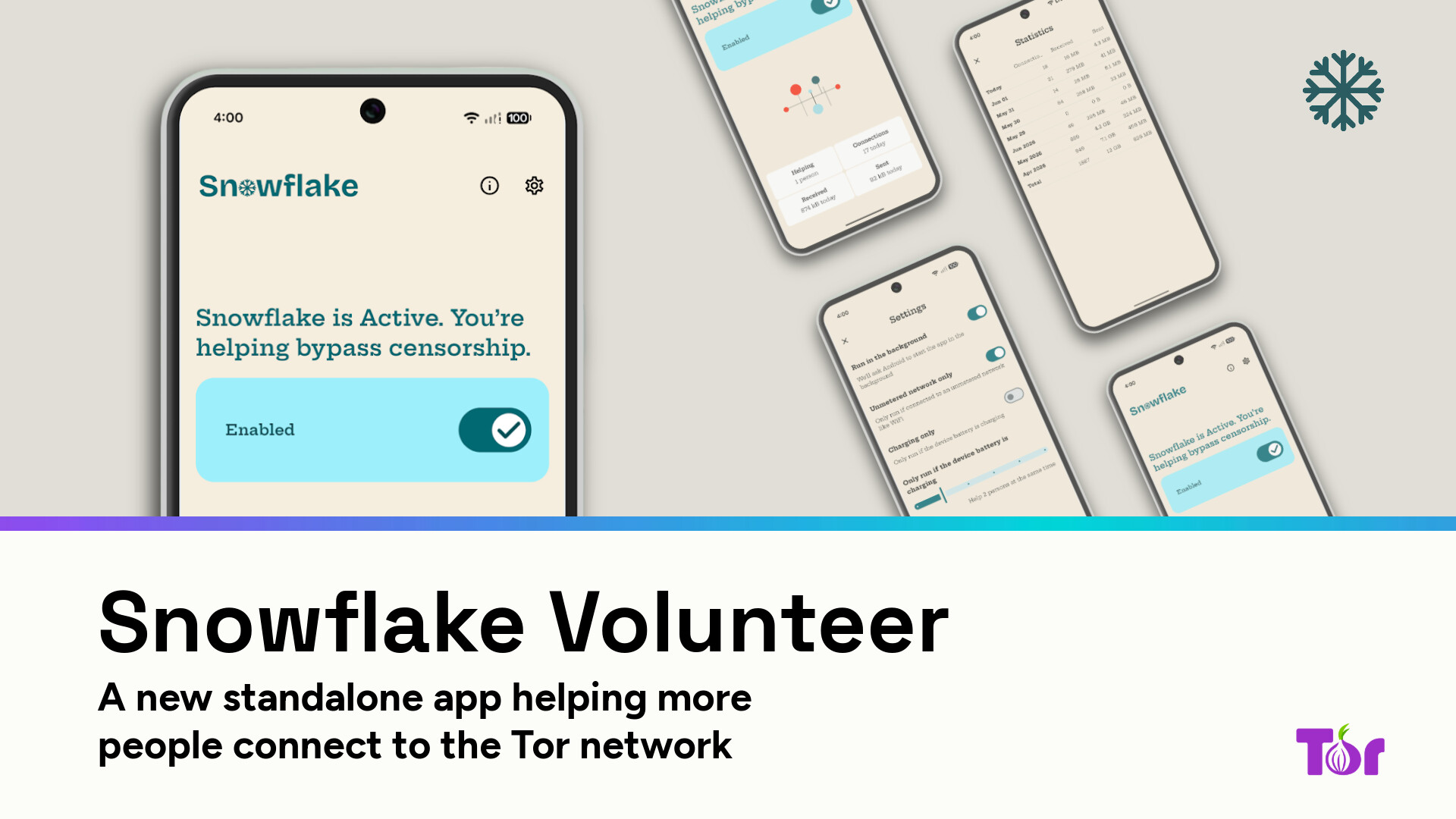
We've written before that Snowflake is the lowest-barrier way to help people reach Tor: open a browser tab, leave it running, and you're relaying anonymous traffic. On 3 August, Tor Project lowered that barrier again with Snowflake Volunteer, a standalone Android app whose only job is being a Snowflake bridge.
The docs site now has an Interactive section holding three pieces, all centred on Tor. The one carrying the most data is the Tor Relay Globe, which plots nearly ten thousand running relays onto a sphere. Over sixty percent of them sit in the United States, Germany and the Netherlands.
Building it meant checking more than twenty public datasets. Six made it in. Almost nothing failed for technical reasons: the APIs mostly worked and the formats were clean. What stopped us was terms that do not allow redistribution.
This post sits alongside Tor Project's spotlight series article on OONI. The body below summarises what the original covers and then maps the same workflow onto Sinophone Asia-Pacific — the section the original does not cover, and the main contribution of this post.
For the full narrative on Kenya's High Court case, Tanzania's follow-up litigation, Meduza's public-education framing, and the supporting cases from Egypt, Jordan, and India, please read the original:
This post is based on a guest post on the Tor Blog by Unredacted, with an anoni.net community perspective added for Taiwan and the wider Sinophone region.
Unredacted is a US-based 501(c)(3) non-profit that runs a network of 300+ servers to keep people in heavily censored places connected to the open internet. Their guest post is part of the Tor Blog's spotlight series on organizations defending the free internet, and it opens with a line from a user in China: "You have helped many many people to overcome the great firewall." That kind of message is rare, because people living under censorship usually have no safe channel to send one.
This post highlights what Unredacted builds, and what it looks like from where the anoni.net community sits, in Taiwan.
For people in Iran, the outside internet barely existed for nearly three months. When connectivity started to come back a few days ago, the Tor WebTunnel bridge our community runs began taking on a wave of traffic. That was Iranians who had found a way around the censorship and reconnected to Tor, getting back onto the wider internet.
Wherever you are, you can help
If you have a VPS (a small cloud server) or a physical machine, plus a domain name, you can run a Tor WebTunnel bridge and give people cut off by censorship a way back onto the open internet. Can't run a server? Open a browser tab and run Snowflake instead, it contributes anonymous traffic just the same.
In June 2025, Cure53 completed a penetration test and source code review of TorVPN for Android and its underlying Rust networking layer, Onionmasq. The Tor Project published the results in April 2026. The headline finding: Tor's core tunnel establishment and routing logic held up well. But there are specific technical issues worth understanding if you're recommending or deploying this tool in Taiwan's context.
The Tor Project post, A Server That Forgets: Exploring Stateless Relays, is grounded in real operator experience from Osservatorio Nessuno in Italy. It is not just a technical tour. It asks a basic trust question: if a relay can be seized, searched, or physically cloned, what exactly can an adversary still learn?
First, the article starts from actual seizure and raid precedents. That makes the threat model concrete. Relay operators are not debating abstract malware only; many are planning for legal process and physical hardware exposure.
Second, it gives a rare end-to-end map of the stack: TPM, measured boot, remote attestation, RAM-only runtime, VM images, and tooling paths such as Patela and stboot. Most discussions in our region cover one layer at a time. This one connects them.
Third, it keeps the hard parts visible. Re-sealing after updates, conflicts between stateless images and unattended upgrades, memory ceilings without swap, and the risk of losing a Stable flag due to restarts are all left as open engineering work, not hidden in marketing language.
A stateless system reboots into a known image and does not keep writable disk state. In security terms, this shifts defaults:
physical seizure yields less forensic material;
configuration drift is constrained by declarative rebuilds;
persistence across reboots becomes harder for attackers;
reproducibility and auditability become more realistic goals.
For Tor relays, there is one unavoidable tension: identity must survive reboots. Relays build reputation over time through long-term keys. If keys disappear on every boot, the node loses its standing and utility.
That is where TPM-backed key handling matters. Keys can be bound to measured boot state and used without handing raw private key material to the operating system. Remote attestation can then let an external verifier check what software stack actually booted. But the limitations are real too, including key-type mismatches and operational complexity.
Arti is Tor’s next-generation Rust implementation. The 2.2.0 release is notable because it pushes a previously experimental access path into day-to-day usability: HTTP CONNECT is now included in full builds and enabled by default, sharing the same port as SOCKS.
For teams operating in filtered enterprise, campus, or public networks, that matters immediately. For developers embedding Arti, this release also expands RPC ergonomics with non-blocking requests, event-loop integration, and a new superuser administration path. In one version, Arti improves both network practicality and operational controllability.
In February 2026, anarcat from the Tor system administration team (TPA) published a post titled \"Keeping track of decisions using the ADR model\".
After reading it, we felt it offered a very practical way to think about proposals, decision-making, and how to write things down so that people can actually find and understand them later.
This post is not a translation of the original article. Instead, it is our own summary and reflection on:
what problem TPA was trying to solve with ADRs,
what they actually changed in their process,
how other projects handle proposals and decisions, and
how this connects to the context we are familiar with.