Threat modeling
Threat modeling is the habit of asking, before you pick a tool, what exactly am I protecting, and from whom? It is the single most useful security skill, and also one of the few topics where the English-language canonical guide is genuinely hard to improve on.
We point outward on this one
EFF's Your Security Plan is the reference we use, and it is translated into Thai, Vietnamese, and Burmese among other languages. We don't reproduce it here. This page adds only the regional framing, then sends you there.
The five questions
EFF frames threat modeling as five questions, worth keeping on a single sheet of paper:
- What do I want to protect? (your data, your location, who you talk to)
- Who do I want to protect it from? (the adversary)
- How likely is it that I will need to protect it?
- How bad are the consequences if I fail?
- How much trouble am I willing to go through to prevent those?
The threat model checklist turns questions one, two and five into something you can click through, and flags the combinations that will not hold. It runs in your browser, saves nothing unless you ask it to, and works offline. Questions three and four stay yours to judge, and the section below is why.
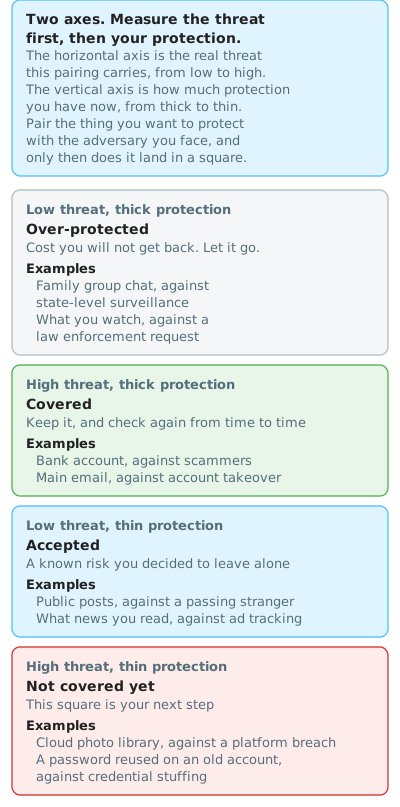
Laying the answers out this way turns a list into a decision. The horizontal axis carries questions three and four together, how likely a pairing is and how bad it would be. The vertical axis is what you already have in place. The bottom right box is the work queue, and the top left box is cost you can reclaim.
That top left box is the one people skip. Reviewing a security plan usually means hunting for gaps, and moving effort away from somewhere it earns nothing matters just as much, particularly when the answer to question five was already tight.
Why the adversary is regional
The reason this matters on a Sinophone Asia-Pacific site: the adversary in question 2 changes shape across jurisdictions, and so does the cost in question 4. The same action, using a pseudonymous account, carrying a phone across a border, reaching a blocked service, carries very different consequences in Taipei, Hong Kong, Kuala Lumpur, or across the Myanmar border. A threat model built for one jurisdiction does not transfer unchanged to the next. When you move across the region, re-run the five questions for where you are now.
Three factors pull the answer to question two upward regardless of jurisdiction: how publicly you speak, whether you work with exile communities or cross-border advocacy networks, and whether you or a close collaborator has family still living in mainland China or Hong Kong. All three appear as selection criteria in the September 2026 Anthropic abuse report, summarized with page numbers in our notes on it, and the capability limits of that layer are in what surveillance can actually do.
For the vocabulary the five questions assume, see anonymity, privacy, pseudonymity, and confidentiality.
Where to go from here
- Your Security Plan — the canonical walkthrough, in multiple languages
- Anonymity, privacy, pseudonymity, and confidentiality — the four properties a plan trades between
- How platforms collect your data, and the microphone question — what the "platform business model" adversary actually reaches, and what the evidence says about microphones
- Maintaining multiple online identities — when the plan says some activity has to be kept off your named identity, this decides how many layers and how to sustain them
- What surveillance can actually do — the capability limits behind question two, layer by layer and sourced
- What an ordinary person should actually do — the plan already worked out for a reader with no specific adversary, ordered by how much each measure blocks
- Scenarios — worked threat models for specific roles and situations