The previous release went out on 2 September. Between then and the 20th, the docs site merged 140 pull requests. The Lab went live, the utilities grew from 9 tools to 15, nine worked examples string those tools into paths you can follow end to end, a settings drawer collects controls that used to be scattered, and the surveillance page gained a fifth tier. On the content side, three regional pages went up, one of them taking forty-nine public sources to pull apart identity binding and the data market beside it. The last two sections are for readers who acted on the old guidance.
On 10 September 2026 Anthropic published Detecting and countering misuse of AI: September 20261, a 154-page account of misuse it detected and disrupted between December 2025 and August 2026. The report is English-only and our community does not have the capacity to translate it in the near term, so we took on something smaller: a complete write-up of the sections that involve Taiwan and the Chinese state, each marked with its page number so readers can check the original.
The sections below aim to give readers who never open the report the full picture rather than fragments. Tables, figures and terminology follow the original as closely as possible.
We are a group of volunteers working on anonymity networks and internet freedom, based in Taiwan. We maintain this documentation site. The community also built asian-diceware, a 7,776-word English passphrase wordlist that drops straight in for the EFF Large Wordlist, with one difference: it pins 292 Asian loanwords that English dictionaries already carry. tofu, oolong, boba, and kimchi are all in there.
The tool page already covers how to use it, and the passphrase generator in the tools section is one click away. This post covers the other half: how the words were picked, and what got rejected along the way.
Global Gathering 2026, hosted by Team CommUNITY, runs from 4 to 6 September in Estoril, Portugal. We applied for a booth and the slot is now confirmed.
Date and time: 6 September, 13:00 to 15:00 WEST (UTC+1, Portugal local time during the event)
Several pages changed over the past two weeks, and in most cases the change was to withdraw a passage rather than extend it. Hong Kong moved from medium to high risk for device inspection, the exemption for eSIMs bought outside Japan came out, a 2FA app we recommended turned out to have changed owners, and a blocking distribution drawn from 40 samples was recomputed over all 22,105. The site merged 50 pull requests between 27 July and 10 August, and a sizeable share of them went into corrections of this kind. What follows is page by page: what changed, what the evidence was, and a checklist in the middle for anyone who already prepared using the old guidance.
The schedule is set and all sixteen speakers have confirmed. Across Aug 8 and 9 in room TR-510 at National Taiwan University of Science and Technology, the track runs from how censorship works and browser-fingerprint tracking, through the NTNU campus Tor node and data-privacy rights in the national health-insurance database, to the anonymous-payments session co-organized with ETHTaipei on the Aug 8 afternoon. Right now exactly one person is covering on-site operations.
Changeovers on Aug 9 are only five minutes long. Someone needs to raise the time card before a speaker runs over, and someone needs to use those five minutes to get the next speaker on stage with projection and audio tested. Several speakers have asked not to be recorded, so someone has to watch the whole way through and confirm nothing was captured. That one is unrecoverable if it goes wrong. On the Aug 8 morning there are invited civil-society groups and independent journalists arriving, so someone needs to greet people at the door and help them find seats.
We are looking for three on-site crew
Roles: recording (1), front-of-room runner (1), door runner (1)
Requirements: no background in Tor, anonymity networks, or any privacy technology
Availability: both days is ideal, one day is welcome too, and we will rotate shifts if enough people sign up
To sign up or ask: reach us through any channel on contact and tell us which role you want and which days you can make
This post is based on a guest post on the Tor Blog by Unredacted, with an anoni.net community perspective added for Taiwan and the wider Sinophone region.
Unredacted is a US-based 501(c)(3) non-profit that runs a network of 300+ servers to keep people in heavily censored places connected to the open internet. Their guest post is part of the Tor Blog's spotlight series on organizations defending the free internet, and it opens with a line from a user in China: "You have helped many many people to overcome the great firewall." That kind of message is rare, because people living under censorship usually have no safe channel to send one.
This post highlights what Unredacted builds, and what it looks like from where the anoni.net community sits, in Taiwan.
For people in Iran, the outside internet barely existed for nearly three months. When connectivity started to come back a few days ago, the Tor WebTunnel bridge our community runs began taking on a wave of traffic. That was Iranians who had found a way around the censorship and reconnected to Tor, getting back onto the wider internet.
Wherever you are, you can help
If you have a VPS (a small cloud server) or a physical machine, plus a domain name, you can run a Tor WebTunnel bridge and give people cut off by censorship a way back onto the open internet. Can't run a server? Open a browser tab and run Snowflake instead, it contributes anonymous traffic just the same.
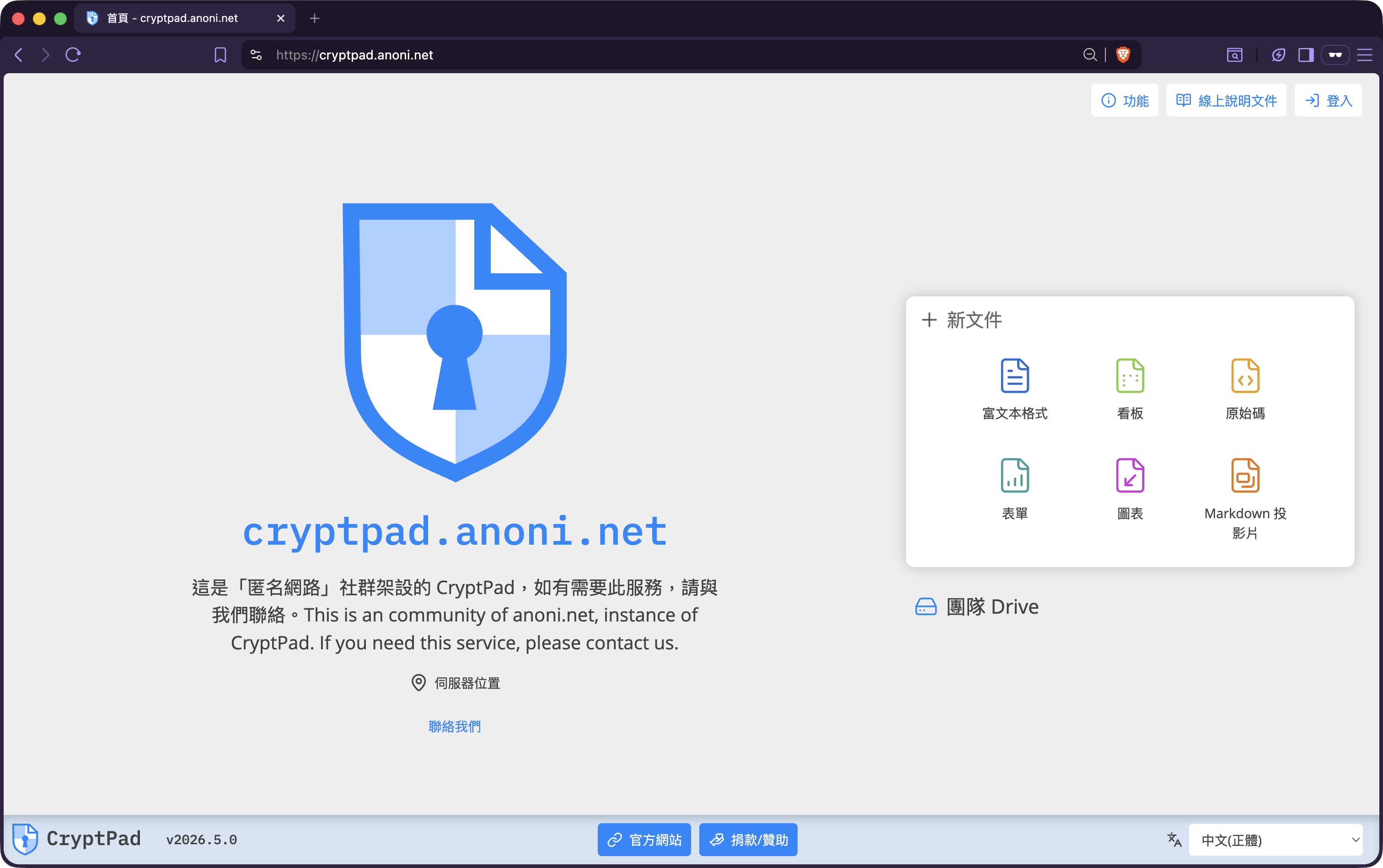
cryptpad.anoni.net Drive home after switching to 中文(正體). Every file category and app entry is localised.
For people who want a collaboration tool that does not silently keep a readable copy of their work on the server, the practical options are short. Google Docs, Notion, Microsoft 365 are excellent products, but every paragraph and every revision sits on those vendors’ servers in a form they can read. From there, algorithms, ads, training corpora, and government data requests each have their own path in.
That difference is exactly what matters when a journalist drafts a story that cannot leak, when a campaigner negotiates a strategy that cannot be wiretapped, when an NGO records distress reports from vulnerable users, or when a researcher works on a politically sensitive topic. Whether a first draft can be safely written at all often turns on that one architectural choice.
CryptPad is one of the few collaboration suites where the server genuinely cannot read what you wrote. Content is encrypted in your browser, the server only ever sees ciphertext, and yet a single interface covers most of what people normally reach for in Google Docs, Sheets, Slides, kanban boards, whiteboards, forms, and calendars.
Until recently the suite had one obvious gap for one large group of users: the UI shipped in English and Simplified Chinese only, with Traditional Chinese (zh_Hant) missing. From the first upstream PR opened at the end of 2023, through two and a half years of patient string-by-string work in Weblate, to the CryptPad 2026.5.0 “🌷 Spring release” on 2026/05/13, zh_Hant is now a built-in locale. The community-hosted cryptpad.anoni.net has been upgraded. Open cryptpad.anoni.net today and the Drive, the document editors, and the share-permission dialog are all in Traditional Chinese. Readers in Taiwan, Hong Kong, Macau, and across the Chinese-reading diaspora can use it without first learning an English menu.
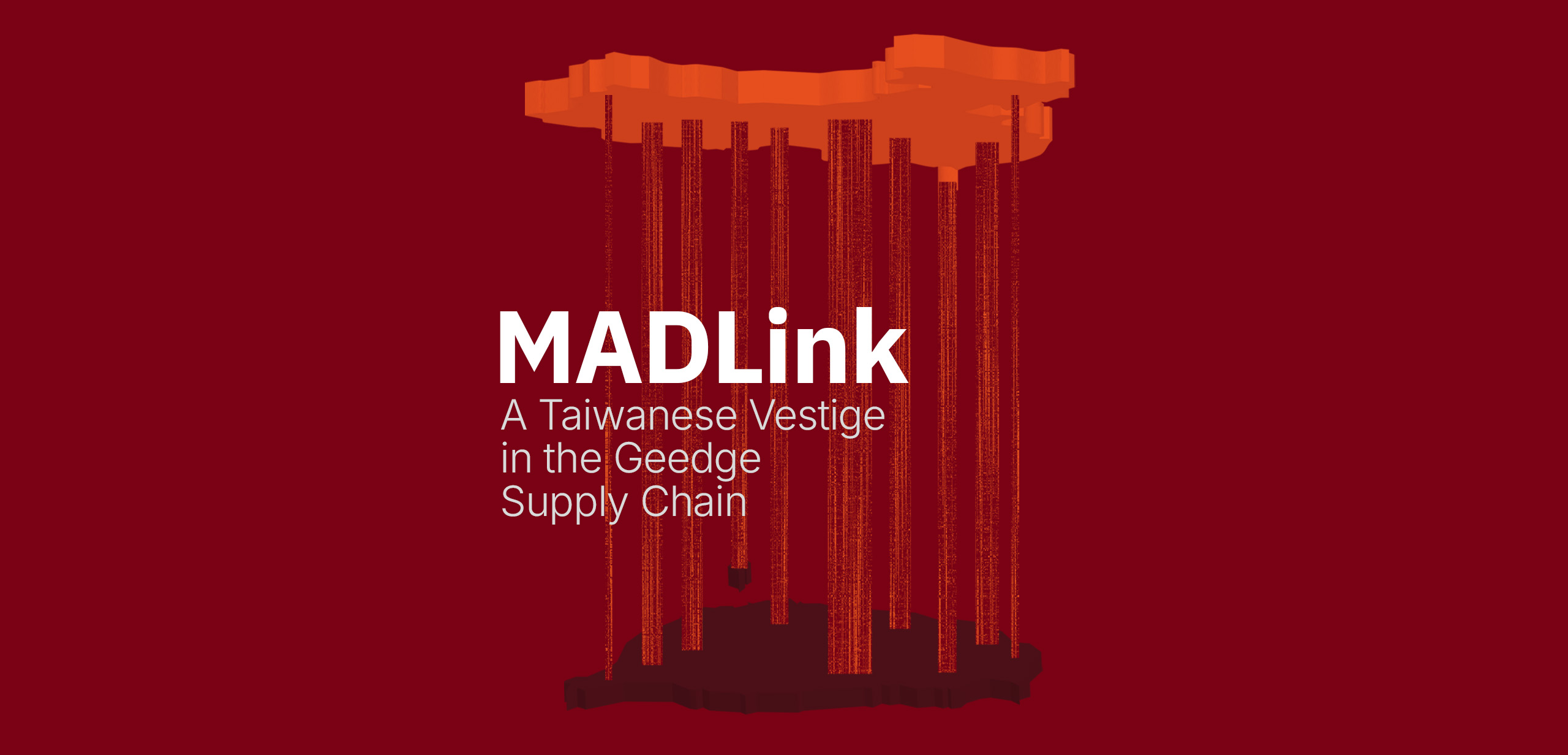
A publicly listed Taipei-traded company shipped 1,708 CSA-7400 high-density network platforms to a Chinese customer between 2019 and 2020. Those appliances ended up in Kazakhstan running a national-grade internet censorship and surveillance system. The supplier was ADLINK Technologies (TWSE: 6166), the customer was Geedge Networks, and the system they ran was the flagship Tiangou Secure Gateway (TSG), an offering whose capabilities rival China's Great Firewall.
That is the central finding of MADLink: A Taiwanese Vestige in the Geedge Supply Chain, InterSecLab's April 2026 report and the first follow-up to their September 2025 The Internet Coup. The anoni.net community has completed the Mandarin (Taiwan terminology, zh-TW) translation. Unlike the previous Internet Coup release, this round also ships an editorial observation page mapping how Taiwan's media, government, and legislators have received the report — with an English summary written for international readers.