Scenarios
Tools are neither good nor bad in the abstract. Their value depends on whether they map to a specific situation, threat model, and set of people the writer cares about. The scenarios in this section are written for readers whose situations sit across, between, or in the shadow of Sinophone Asia-Pacific jurisdictions — diaspora, cross-border travelers, people with family in less open environments, and people moving across the region for work, study, or refuge.
Scenarios connect the conceptual frame and the regional observatory to specific lived practice.
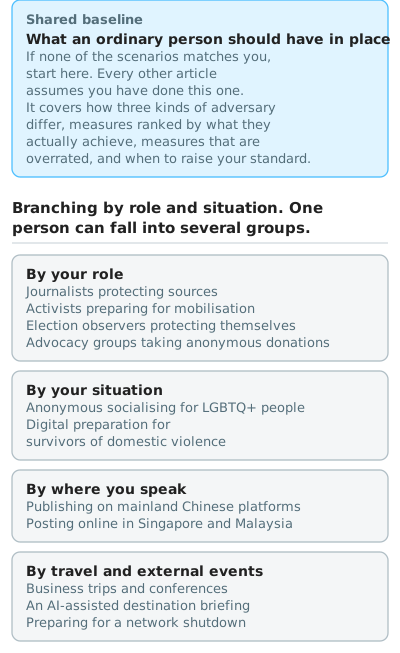
If none of them matches your situation, what an ordinary person should actually do is the baseline the rest of this section builds on, and it lists what should make you escalate to a specific scenario.
Hong Kong and Macau readers: expect a higher risk tier
Most of the scenarios below default to Taiwan or general Sinophone Asia-Pacific examples. Read that framing as a floor, not a ceiling, for Hong Kong. Since the 2020 National Security Law and the 2024 Safeguarding National Security Ordinance, national-security offenses carry sentences measured in years rather than fines, national-security police can seize and forensically examine a device under warrant, and the local civil-society organizations that once absorbed this kind of risk have largely dissolved since 2021. Where a scenario below assumes a functioning local NGO safety net, that assumption often no longer holds; the activists and journalists pages route Hong Kong readers to international organizations instead. Macau's environment differs again and is comparatively under-documented here.
Available now
- What an ordinary person should actually do — start here if none of the roles below is yours. Three kinds of adversary and why they need different answers, the common advice ordered by how much it actually blocks, what is overrated, and the triggers that mean you should move to one of the pages below.
- LGBTQ+ and sexual minorities — anonymous social life across the Sinophone region — account layering paced to disclosure, dating-app risk, family-controlled device traces, cross-border travel preparation, and a full regional context section covering Mainland China, Hong Kong & Macau, Singapore, Malaysia, Taiwan, and the diaspora. The general layering setup is in maintaining multiple online identities.
- Domestic violence and tech-enabled abuse — how abusers use shared accounts, location tracking, and stalkerware, how to check and respond without escalating, and why leaving is the highest-risk moment; written for survivors and the people helping them, with regional helplines.
- Journalists and source protection — the source-protection lifecycle and why communication metadata can burn a source even when content is encrypted; consent and what a source actually agreed to, sources who can't use the standard tools, and keeping multiple sources apart from each other; concise, routing depth to Freedom of the Press Foundation and EFF, with the regional angle of sources inside less open jurisdictions including mainland China.
- Activists and protest digital safety — a brief regional companion to EFF's protest guide: real-name SIM, border device searches, network-level observation, coordination metadata, and pre-event venue detail. The last two apply equally to churches, associations, and anything else with a fixed meeting place.
- Posting on mainland Chinese platforms — the environment after real-name registration and the 2025 national Cyberspace ID, why reach and safety pull against each other, where the risk lands (including group administrators and onward forwarders), and the archiving work already carried by CDT, GreatFire, and Citizen Lab.
- Speaking online from Singapore and Malaysia — the Singapore–Malaysia online-speech laws (POFMA, FICA, CMA Section 233, sedition) and real-name identity layers, and how to reduce legal and identification exposure, for the Sinophone community and diaspora.
- Election observer self-protection — the individual operational-security layer that org-level guidance from GNDEM, NDI, and ANFREL leaves open: device prep, secure reporting, seized-device exposure, harassment, and cross-border accreditation.
- Cross-border travel and device searches in Asia — general device-minimization OPSEC plus Asia-specific border-search context and the burner question (whether you need one, whether buying abroad buys anonymity, and what changes when you bring it home), because the canonical English guide describes only US law and misleads travelers in Asia.
- Pre-departure digital safety — brief yourself with AI prompts — copy-paste prompts you feed to your own AI to get a destination's censorship, legal, SIM, and emergency-contact picture before you travel; works for any country, and no query reaches us.
- Preparing for and responding to a network shutdown — four levels of outage and how to tell them apart, what to finish beforehand, the full process for agreeing arrangements with other people, the risks in the moment connectivity returns, and Taiwan's undersea cable and grid context.
- Anonymous donation channels for advocacy organizations — a working design for legally anonymous giving that protects donors while keeping the organization accountable, for both organizers and donors, with Sinophone Asia-Pacific banking, crypto, and cross-border context.
How to suggest a scenario
If you work with a population whose situation isn't well covered by existing English-language privacy sites, especially groups with significant cross-border or Sinophone-region context, let us know via the channels on the Community page. We are particularly interested in scenarios where the regional framing is load-bearing: the same situation in a different jurisdiction would call for materially different practice.
Other paths
- Regional observatory for empirical observations
- Basics: networked freedom for the conceptual frame
- About us for the community behind the writing
- For introductory privacy material outside our regional scope: EFF Surveillance Self-Defense, Privacy Guides