Open a web page and the JavaScript on it can read your graphics card model, its driver details, and the hardware features it supports. Those answers barely change on a given machine, so a tracking company can combine them with other device traits into an identifier that needs no cookie, asks for no consent, and follows you between sites.
The graphics card is one source among many. Font lists, screen dimensions, time zone, and audio processing all feed the same identifier. A browser fingerprint cannot be cleared the way a cookie can covers how the whole mechanism works, why clearing cookies does nothing, and where each browser currently stands. This piece stays with the graphics card.
Brave has handled these signals since version 1.93, on by default on desktop and Android, rolling out in stages1. Three protections ship together: the WebGL vendor and renderer strings become one generic string shared by every Brave user, the WebGPU hardware description fields are cleared, and the list of supported WebGL extensions gets noise added to it.
The first two make every user look alike. The third makes one user look different on every site. Two opposite techniques arrived in the same release, each assigned to a different API, and where that line falls is also where Brave and Tor Browser part company on fingerprinting.
Tian Jian's learning platform TJ Field School is running a two-session series on digital security and privacy. Toomore from our community gave the first session on 12 August, and Mashbean takes the second on 26 August. Registration is still open.
Taiwan has long gone without large-scale throttling or shutdowns. That is good for daily life, and for anyone trying to understand network anomalies it means there is no local sample to compare against. OONI is a long-running open source project measuring network interference and connection quality worldwide; anyone can install its app to contribute, and every result is published. Taiwan's record in that database has consistently shown a network working normally.
In the 30 days before 13 August, the three mobile carriers in Taiwan recorded 564 successful connection speed tests (the test is named ndt), with a median download of 12,425 kbit/s and only 4 measurements below 2,000 kbit/s, two of which were failures. kbit/s counts thousands of bits transferred per second — higher is faster, and 1,000 kbit/s is roughly 1 Mbps.
From 14:30 to 15:00 Taipei time on 13 August, mobile networks across seven northern counties were throttled for 30 minutes. Two days earlier the community put out a call asking people to run OONI Probe's performance tests during that window. Taiwan recorded 238 connection speed tests and 235 video streaming tests (named dash) that day, with 170 and 168 of them completed on mobile networks, coming from 47 devices. During the equivalent window at the central Taiwan drill on 10 August, the whole country produced zero mobile performance measurements.
The call started with community member mashbean, who proposed using the drill as a rare measurement opportunity. The two sides then prepared separately, one writing the call and the operating instructions, the other observing in the field on the day. He wrote his own record up as a separate post, which follows the network past the announced end of the drill and covers a period this dataset cannot see. Read together, the two posts span the full afternoon.
One Chunghwa Telecom Mobile handset measured 788 to 1,709 kbit/s during the throttle. Taiwan's public data had never shown figures of that order. It should be said up front that those figures come from 6 records left by a single device: enough to stand as one complete case, not enough to generalise to the country or to any carrier.
This post records network conditions. Whether carriers followed instructions precisely, and whether the officially published figure is accurate, are both outside its scope. Taiwan had no data on what throttling looks like, and preserving these 30 minutes is the point. Every query below works without authentication or an API key, so readers can run them again.
The most useful thing to come out of the analysis has nothing to do with throttling itself. It is a reading method: throttling and blocking produce completely different shapes in OONI data. Blocking sends anomaly rates up and leaves confirmed-blocking records behind, while throttling leaves the verdict fields untouched and shows up only in throughput and latency values. Taiwan's web connectivity anomaly rate that day was 1.0%, in the same band as the usual 0.6%, with confirmed blocking at 0 all day. Only speed went down. Describing a throttle through blocking anomaly rates returns a figure close to normal, and leads to the conclusion that nothing happened.
On Thursday 13 August, from 14:30 to 15:00 Taipei time (UTC+8), mobile networks in Keelung, Taipei, New Taipei, Taoyuan, Hsinchu City, Hsinchu County, and Yilan will be throttled for thirty minutes. The throttle is part of Taiwan's Urban Resilience Exercise, executed simultaneously by all three major carriers. Official announcements state that voice calls, SMS, and cell broadcast continue to work, and that high-bandwidth services degrade: video streaming, video calls, mobile payments, cloud sync.1 The advice for the window from the NCC (National Communications Commission, Taiwan's telecom regulator) is to prepare in advance for going offline.2
Officials have described the depth of the throttle twice. On 20 July, Defence Minister Wellington Koo told the Legislative Yuan (Taiwan's parliament) that speeds would drop to one percent of 4G and 5G capacity. After the central Taiwan drill on 10 August, the Executive Yuan (Taiwan's cabinet) described the method: carriers apply rate limiting in the core network, capping mobile download speeds at 256KB. The two statements are of the same order, and either one gives a figure to expect when the measurements come in.
The date, the window, the seven counties, the three carriers: every boundary of this throttle is public before it runs. Studies of network throttling rarely get that. In most cases users notice slowness first and researchers reconstruct the timeline afterwards, leaving the edges fuzzy. Pre-announced shutdowns are not new elsewhere, exam-period national shutdowns being the familiar example.6 On the publicly documented record, a pre-announced throttle is less common, particularly one with per-carrier granularity.
During the same window at the central Taiwan drill on 10 August, Taiwan's OONI observations contained no performance measurement from a mobile network at all. The northern drill is the last of this year's exercise, so after 13 August the opportunity does not come round again.
If you are in one of those seven counties, your phone is going to slow down for that half hour regardless. Rather than just waiting it out, you might as well leave a record behind.
Several pages changed over the past two weeks, and in most cases the change was to withdraw a passage rather than extend it. Hong Kong moved from medium to high risk for device inspection, the exemption for eSIMs bought outside Japan came out, a 2FA app we recommended turned out to have changed owners, and a blocking distribution drawn from 40 samples was recomputed over all 22,105. The site merged 50 pull requests between 27 July and 10 August, and a sizeable share of them went into corrections of this kind. What follows is page by page: what changed, what the evidence was, and a checklist in the middle for anyone who already prepared using the old guidance.
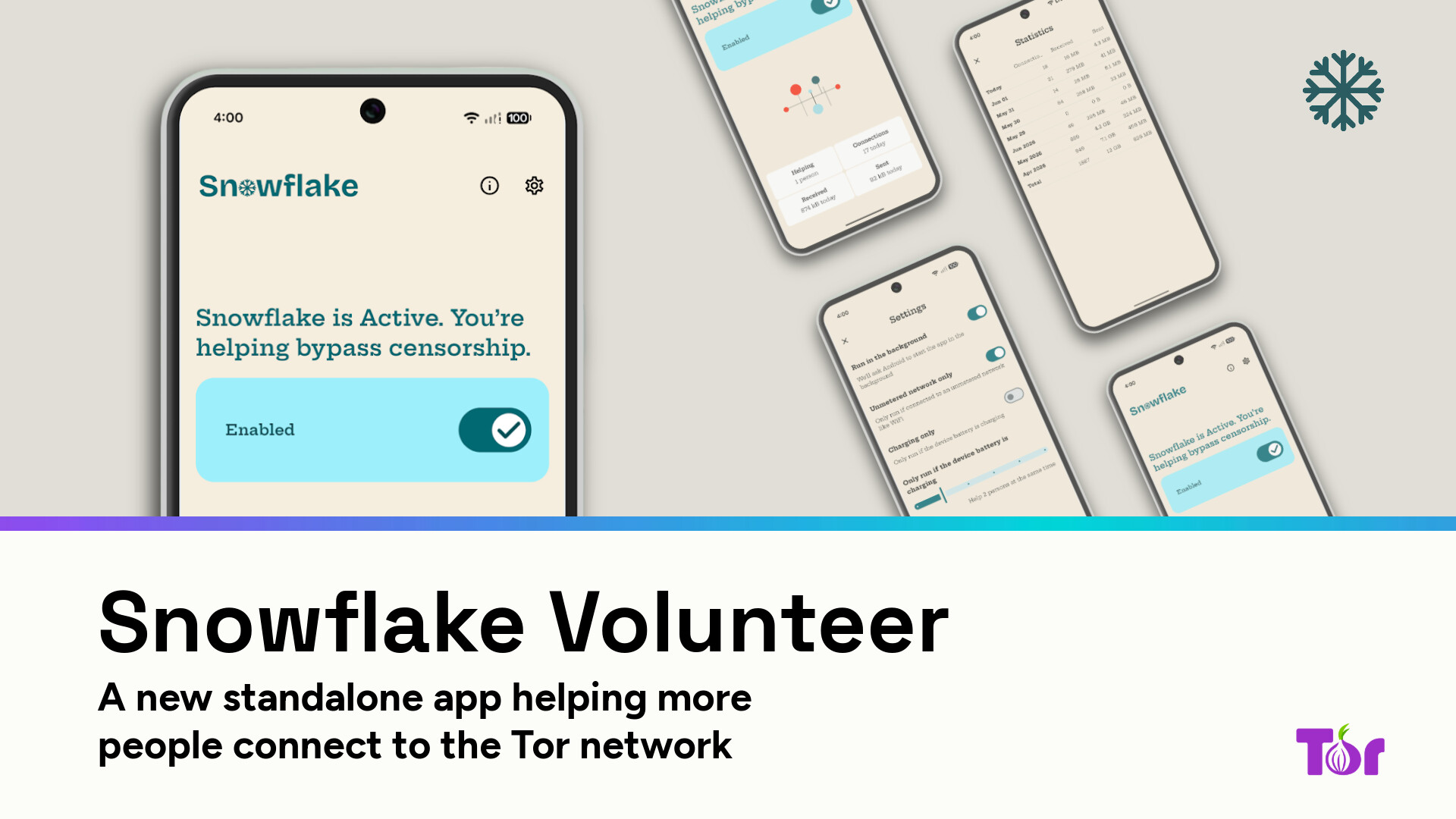
We've written before that Snowflake is the lowest-barrier way to help people reach Tor: open a browser tab, leave it running, and you're relaying anonymous traffic. On 3 August, Tor Project lowered that barrier again with Snowflake Volunteer, a standalone Android app whose only job is being a Snowflake bridge.
The docs site now has an Interactive section holding three pieces, all centred on Tor. The one carrying the most data is the Tor Relay Globe, which plots nearly ten thousand running relays onto a sphere. Over sixty percent of them sit in the United States, Germany and the Netherlands.
Building it meant checking more than twenty public datasets. Six made it in. Almost nothing failed for technical reasons: the APIs mostly worked and the formats were clean. What stopped us was terms that do not allow redistribution.
This post sits alongside Tor Project's spotlight series article on OONI. The body below summarises what the original covers and then maps the same workflow onto Sinophone Asia-Pacific — the section the original does not cover, and the main contribution of this post.
For the full narrative on Kenya's High Court case, Tanzania's follow-up litigation, Meduza's public-education framing, and the supporting cases from Egypt, Jordan, and India, please read the original:
The schedule is set and all sixteen speakers have confirmed. Across Aug 8 and 9 in room TR-510 at National Taiwan University of Science and Technology, the track runs from how censorship works and browser-fingerprint tracking, through the NTNU campus Tor node and data-privacy rights in the national health-insurance database, to the anonymous-payments session co-organized with ETHTaipei on the Aug 8 afternoon. Right now exactly one person is covering on-site operations.
Changeovers on Aug 9 are only five minutes long. Someone needs to raise the time card before a speaker runs over, and someone needs to use those five minutes to get the next speaker on stage with projection and audio tested. Several speakers have asked not to be recorded, so someone has to watch the whole way through and confirm nothing was captured. That one is unrecoverable if it goes wrong. On the Aug 8 morning there are invited civil-society groups and independent journalists arriving, so someone needs to greet people at the door and help them find seats.
We are looking for three on-site crew
Roles: recording (1), front-of-room runner (1), door runner (1)
Requirements: no background in Tor, anonymity networks, or any privacy technology
Availability: both days is ideal, one day is welcome too, and we will rotate shifts if enough people sign up
To sign up or ask: reach us through any channel on contact and tell us which role you want and which days you can make
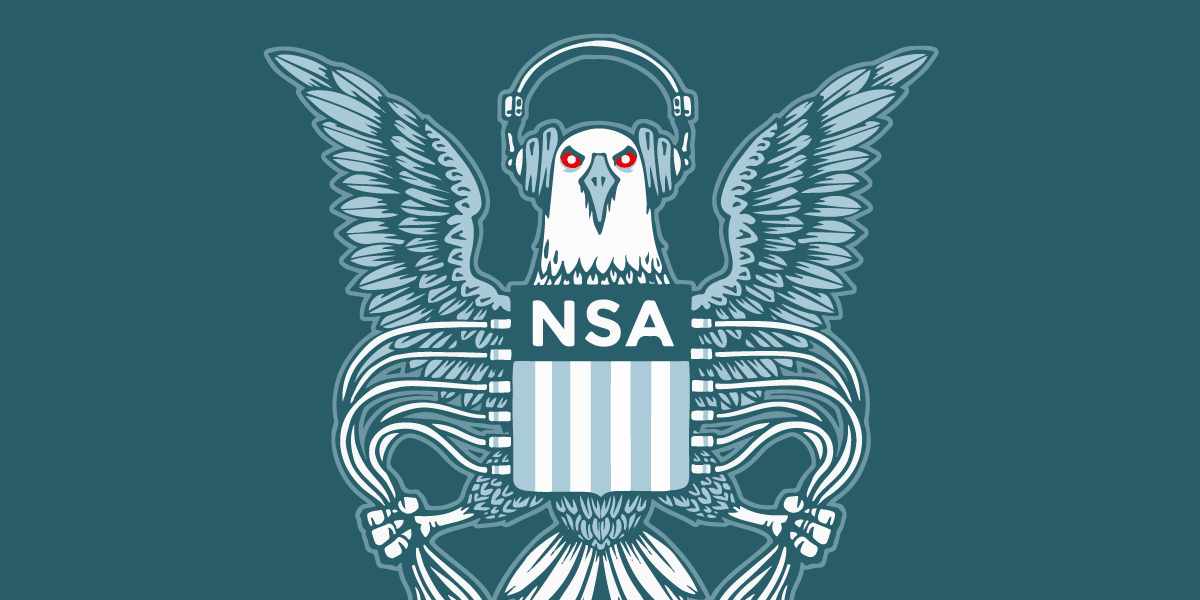
Image: EFF designer Hugh D'Andrade's "NSA eagle," which reworks the NSA seal into an eagle plugging its talons into the nation's telecom lines. From EFF's NSA spying work, licensed under CC BY 4.010.
This post is an anoni.net reading based on the EFF Deeplinks article:
At midnight on 12 June 2026, Section 702 of the Foreign Intelligence Surveillance Act lapsed1. EFF, which spent years arguing the program should require a warrant before the FBI reaches Americans' communications — or else expire — calls the lapse a victory1.
It is a real victory, and a narrow one. Section 702 was always built to collect the communications of non-US persons located abroad. That means everyone outside America — including readers in Taiwan, Hong Kong, mainland China, Macau, Singapore, and Malaysia — has always been a lawful target of this authority. The fight that just lapsed it was overwhelmingly a fight about protecting Americans. For the rest of us, the lapse changes much less than the headline suggests.