JoinAnonymous Payments TrackFATF, the body that sets anti-money laundering standards
Taiwan's anti-money laundering regime, origins and current supervision
On this page
- Rules at the bank counter
- Why Taiwan follows FATF standards
- An early law, then twenty years of little follow-through
- The Mega Bank case and the timing of reform
- A system built in three years
- Legislation centred on fraud
- What it means for readers
- The next evaluation
- Timeline
- FATF Recommendations cited here
- About the data
- Further reading
- Sources
Opening a bank account in Taiwan means showing ID and explaining the purpose of the account. Deposit or withdraw NT$500,000 or more in cash over the counter, and the teller records your identity. When the police flag an account, every transaction on it stops; at the end of 2025 more than 150,000 accounts in Taiwan were flagged.
Some of these rules come from the recommendations of the Financial Action Task Force (FATF); others Taiwan added on its own to fight fraud. Large cash reporting and flagged accounts existed before 2016. After New York regulators heavily fined Mega Bank's New York branch in 2016, Taiwan widened the scope of customer checks and raised fines within three years. Later amendments turned to fraud, and restrictions reached beyond banks' internal procedures to individuals' accounts.
This article belongs to the FATF series in our anonymous payments research track; see the series overview for the reading order. For where the FATF came from, how it works and where Taiwan sits in the Global Network, see FATF, the body that sets anti-money laundering standards. What the FATF requires of virtual assets and virtual asset service providers (VASPs) will be covered in a later article.
Rules at the bank counter
| What you run into at the bank | The rule | Since | Where it comes from |
|---|---|---|---|
| Showing ID and explaining the purpose when opening an account | Risk-based customer identification, understanding the purpose and nature of the relationship | 2017 | Required by the FATF (Recommendation 10) |
| Being asked where money comes from, or for more documents | For higher-risk customers or where necessary, banks must understand the source of funds | 2017 | The FATF requires a risk-based approach; each bank judges the details (Recommendations 1 and 10) |
| Being asked whether you hold a prominent political position | Enhanced checks on politicians, their families and close associates | 2017 | Required by the FATF (Recommendation 12) |
| Sending NT$30,000 or more abroad over the counter without an account | Identity must be verified | 2017 | Required by the FATF (Recommendations 10 and 16) |
| Depositing or withdrawing NT$500,000 or more in cash over the counter | Identity recorded; the bank reports to the Investigation Bureau | Before 2016 | The FATF only asks countries to consider such a system (interpretive note to Recommendation 29) |
| Carrying foreign cash worth more than US$10,000 across the border | Declare it to customs | Before 2016 | Required by the FATF (Recommendation 32, with a maximum threshold of US$15,000) |
| An account flagged for fraud | All transactions suspended for two years, extendable once by one year | 2006 | Taiwan's own system |
| Handing your account to someone else | A police warning, then five years of limits on ATM transfers and withdrawals and no online banking | 2023, 2024 | Taiwan's own system |
The first four rows are customer due diligence that the FATF requires of every country; what differs is how strictly it is applied. How far a bank asks about the source of funds is a risk judgement, so the same person may meet different demands at different banks. Large cash reporting is a system Taiwan chose to set up; the FATF only asks countries to consider it. Taiwan's cross-border cash threshold of US$10,000 is also lower than the maximum the FATF allows. The last two rows target mule accounts and fraud, and how they are designed and changed is a matter for Taiwan's own legislative process.
Why Taiwan follows FATF standards
Taiwan is not a member of the FATF, and the FATF's recommendations are not a treaty and carry no penalties (for where their force comes from, see our FATF overview). In 1997 Taiwan became a founding member of the Asia/Pacific Group on Money Laundering (APG) under the name Chinese Taipei. Under the APG's Terms of Reference and membership rules, members implement the FATF's 40 Recommendations according to their own legal frameworks, and on joining they commit to mutual evaluations by other members. Members with the worst results are referred to the FATF for review and may end up on the grey list. The FATF does not ask countries to apply enhanced due diligence to grey-listed jurisdictions, only to take the list into account in their risk analysis, and banks often treat the list as an indicator when assessing the risk of a relationship.
In its 2019 evaluation, Taiwan was placed in regular follow-up, the lightest follow-up level. The effectiveness outcomes are the 11 areas where evaluators check whether a system actually works; Taiwan was rated substantially effective on 7 of them, second only to the United States among the 42 APG members.
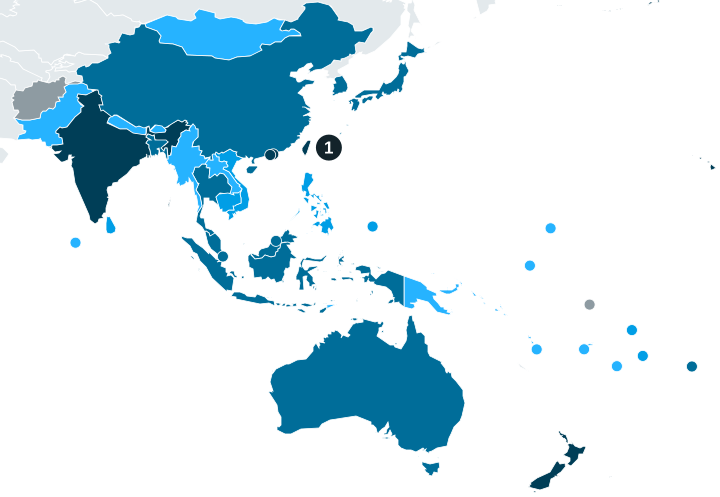
Effectiveness ratings of APG members; ① is Taiwan. The darker the shade in light mode, or the brighter in dark mode, the more outcomes were rated substantial or high. The United States and Canada are outside the map; small island states are shown as dots. Members were assessed between 2015 and 2025, so the comparison only shows the broad picture.
Members at each level
- 6 or more: United States, Taiwan, Hong Kong, India, Macao, New Zealand
- 3 to 5: Australia, Bangladesh, Brunei, Canada, China, Cook Islands, Indonesia, Japan, Korea, Malaysia, Singapore, Thailand
- 1 to 2: Cambodia, Niue, Palau, Philippines, Samoa, Sri Lanka, Vietnam
- 0: Bhutan, Fiji, Laos, Maldives, Marshall Islands, Mongolia, Myanmar, Nauru, Nepal, Pakistan, Papua New Guinea, Solomon Islands, Timor-Leste, Tonga, Vanuatu
- No rating: Afghanistan, Tuvalu
Taiwan's banks rely on foreign correspondent banks for international remittances and US dollar transactions, and their US branches are examined by US regulators. When the Executive Yuan explained what the evaluation meant in 2019, it linked the result to how foreign businesses assess Taiwan's financial environment and to Taiwan's practical participation in international organisations.
An early law, then twenty years of little follow-through
Taiwan enacted its Money Laundering Control Act in 1996, in force the following year; the government describes it as Asia's first dedicated anti-money laundering law. At the same time the Investigation Bureau set up its Money Laundering Prevention Center as Taiwan's financial intelligence unit (FIU), receiving and analysing suspicious transaction reports from financial institutions. Large cash transaction reporting and declarations for carrying cash across the border were written into law over the following years, and the Financial Supervisory Commission issued the rules on flagged accounts in 2006.
After the law was passed, policy was not pursued and public awareness of money laundering stayed low. In the APG's second-round evaluation in 2007, Taiwan was only partially compliant or non-compliant on 24 of 49 Recommendations, and in 2011 its follow-up level was lowered for insufficient progress. When the second round closed in 2014, Taiwan was still in transitional follow-up (for members that had not exited follow-up by the end of the second round, kept under review until the third) alongside Bhutan, Pakistan, Laos, Vietnam and others; the Ministry of Justice gave the reason as unresolved deficiencies. The Executive Yuan, for its part, dates the move into transitional follow-up to 2015. Looking back, the Anti-Money Laundering Office wrote that when the third round got under way in 2015, Taiwan "lagged far behind international standards in its laws, supervision and enforcement". The third-round evaluation was scheduled for late 2018, and the Executive Yuan expected the result to have "a far-reaching impact on the flexibility of the country's overall financial activity".
The Mega Bank case and the timing of reform
In August 2016 the New York State Department of Financial Services (NYDFS) entered a consent order with Mega International Commercial Bank and its New York branch. Mega agreed to pay a US$180 million penalty and to accept an independent monitor chosen by the NYDFS for two years. The order set out three groups of failings:
- Panama transactions: heavy transaction volumes between the New York branch and the Colón Free Trade Zone branch in Panama, while the head office "acted with indifference" to their risks
- Compliance conflicts: the branch's chief compliance officer was also its deputy general manager with business and operational duties, "a clear conflict of interest"
- Weak head-office oversight: the anti-money laundering officer was a head-office employee unfamiliar with US requirements, compliance meeting minutes were not sent to head office, and Chinese-language documents went untranslated
Amounts are credit transactions between the New York branch and the Colón Free Trade Zone branch, from the NYDFS consent order
Customer and transaction checks, a designated compliance officer and head-office oversight of overseas branches, the areas behind all three groups of failings, are FATF requirements (Recommendations 10 and 18) and were what the evaluators would examine two years later.
Six days after the order was published, on 25 August 2016, the Executive Yuan cabinet approved the Ministry of Justice's draft amendment to the Money Laundering Control Act. The ministry's press release that day gave the reasons as meeting international standards and fighting cross-border telecom fraud and cash smuggling by couriers, and used the Mega case as an example of how "Taiwan's anti-money laundering regime urgently needs adjustment". In September the Financial Supervisory Commission fined Mega Bank NT$10 million and removed six senior managers, and the commission's chair and vice chair resigned in October. In 2017 the Control Yuan adopted an investigation report censuring the Executive Yuan, the Financial Supervisory Commission and the Ministry of Finance.
Looking back, the Anti-Money Laundering Office wrote that only after "a domestic bank's overseas branch received a heavy US penalty in 2016" did the issue draw wide public scrutiny in Taiwan.
A system built in three years
The rewritten Money Laundering Control Act took effect in June 2017, and the customer due diligence in the first four rows of the table dates from then. Banks must scale their checks to each customer's risk, identify the people who actually control an account, and apply enhanced checks to politicians and their families. The maximum fine on a bank for failing its reporting and due diligence duties rose from NT$1 million to NT$10 million.
Once the law took effect, banks began asking customers to update their details, and people complained that anti-money laundering had become a "nationwide data update campaign". In late 2018 Bank of Taiwan announced that customers who did not update their details by a deadline would lose online and automated services; the Financial Supervisory Commission ordered the bank to withdraw the notice and set a proportionate deadline. Looking back, the Anti-Money Laundering Office described public attitudes as going "from resistance at the start to gradual acceptance".
From then on, lending your account to a fraud ring, or withdrawing its takings, could also count as money laundering. The old law covered only the proceeds of serious crimes with a minimum sentence of five years; the new law lowered the threshold to six months and listed fraud and similar offences directly.
The Executive Yuan set up the Anti-Money Laundering Office in March 2017 to coordinate preparations, and in July the APG agreed that Taiwan could leave transitional follow-up. In November 2018 the evaluation team spent two weeks in Taiwan checking whether the new system actually worked. Suspicious transaction reports from banks and others rose from 13,972 in 2016 to 35,869 in the year of the visit, then settled at twenty to thirty thousand a year.
2010 to 2024, from the Investigation Bureau's annual AML reports. From 2017 reporting extended to designated non-financial businesses and professions
The evaluation report was adopted at the APG annual meeting in August 2019, placing Taiwan in regular follow-up (for the ratings, see "Taiwan's position" in our FATF overview), and three follow-up reports since have kept it at that level.
Legislation centred on fraud
After the 2019 evaluation, legislation focused on fraud, and restrictions reached beyond banks' operations to individuals' accounts. A 2023 amendment created an offence of collecting other people's accounts without justification and banned handing one's own account to others. A first offence of handing over an account leads to a police warning; criminal liability applies only when there is payment, three or more accounts are handed over, or the person reoffends within five years of a warning.
In 2024 the Act was rewritten in full again, on the same day as the new Fraud Crime Hazard Prevention Act. Financial institutions went from being allowed to restrict a warned person's accounts to being required to. Under the regulator's rules, for five years after a warning ATM transfers and withdrawals are capped at NT$10,000 a day each, and online banking, mobile banking and payment platforms cannot be used. The same amendment moved virtual asset service providers to a registration regime, which a later article will cover.
End-of-quarter figures from the Financial Supervisory Commission, banks (including Chunghwa Post) and credit cooperatives combined
According to the Financial Supervisory Commission, flagged accounts rose from 50,285 in June 2021 to 150,757 in December 2025, then fell to 125,013 by September 2026.
Being asked about the purpose of an account when opening it, and asked to update your details afterwards: in recent years insiders have helped fraud rings at exactly these steps. At Taichung Commercial Bank, branch managers acting on requests from a fraud ring member opened accounts for 12 companies with no real business and raised their transfer limits; prosecutors in Taichung indicted the case in April 2026, putting the laundered sums above NT$3.6 billion. At Bank of Taiwan, a staff member opened accounts for fraudsters outside the branch and uploaded photos of photocopied IDs. The Financial Supervisory Commission fined both banks; Taichung Bank's NT$32 million was, in the words of the head of the Banking Bureau, the largest fine ever imposed on a bank.
What it means for readers
Taiwan's current anti-money laundering regime expanded between 2016 and 2019 for the evaluation, then kept tightening to fight fraud. The rules in the table are all enforced by banks, at the counter and on accounts. The parts that come from the FATF change only when international standards change; the parts Taiwan added itself can be debated in Taiwan's own legislative process.
Personal accounts
Accounts are flagged when courts, prosecutors or police notify the bank for a criminal investigation; all transactions stop at once and incoming transfers are returned. Other accounts opened by the same person become "derivative controlled accounts", with ATM cards, online transfers and other electronic functions suspended. Account holders who dispute a flag must, under the regulations, take it up with the agency that issued the notice, and banks must help where necessary. Handing your account to someone else leads to a police warning; the five years of restrictions that follow are in the table above.
Accounts of civil society groups
Banks cut back on customers they see as high-risk to reduce their own risk (see "The cost and who bears it" in our FATF overview), and Taiwan has no public statistics on how often civil society groups are affected. The 2024 national risk assessment rated civic associations, national religious foundations and social welfare foundations as higher risk, and medical, educational and cultural foundations as lower risk; it did not treat non-profits as a whole as high-risk. The 2019 evaluation report gives insufficient information on anonymous donations as the reason these three were singled out. When a bank asks for more documents or refuses service on the grounds that non-profits are higher risk, the assessment shows which category your group actually falls into. The authorities also encourage non-profits to handle funds through banks.
Article 13 of the regulations governing deposit accounts and suspicious transactions lists the cases in which banks must refuse to open an account, including "other irregularities at account opening for which the customer cannot give a reasonable explanation", a clause that gives banks wide discretion. The Financial Supervisory Commission's simplified measures for low-risk customers state that before asking customers for information, banks "should not simply cite regulatory requirements or contract terms allowing them to terminate business or restrict transactions". Civil society groups whose account applications are refused or whose accounts are restricted can ask the bank to explain the basis, and can also see Anonymous donation channels for advocacy organizations on our docs site.
In one case, fraudsters offered prize draws for small donations and had victims pay into a foundation's public donation account, and the foundation's head was referred to prosecutors. The Taipei District Prosecutors Office declined to prosecute, reasoning that the money had not been quickly withdrawn or moved on, unlike the accounts fraud rings use. The foundation had long warned against scams on its website and stated that it ran no prize draws. Groups with public donation accounts can reconcile them regularly and state on their websites how they accept donations, which makes misuse easier to explain.
The next evaluation
The next evaluation is due in 2030, with Taiwan's report on the agenda of the APG's 2031 annual meeting. In the last round, the years just before the evaluation were when legislation moved fastest, and this round's legislation has already begun. In August 2026 the Executive Yuan approved a new draft amendment to the Money Laundering Control Act and sent it to the legislature. Under the draft, banks and virtual asset exchanges could consult each other and share customer information for anti-money laundering purposes, and government agencies would gain a mechanism to request information from each other. Customer data would flow between more institutions, making this the part of the draft most relevant to privacy. The draft also makes running virtual asset or third-party payment services without registration a predicate offence, and defines beneficial ownership in law.
Timeline
From the 1996 law to the next evaluation, Taiwan's anti-money laundering regime expanded sharply in the three years after 2016; later amendments turned to fraud and virtual assets.
1996–2015An early law, little follow-throughThe law came early but was not followed up, and Taiwan was in transitional follow-up when the second round ended.
- 1996-10Money Laundering Control Act enactedIn force from April 1997, when the Investigation Bureau also set up its Money Laundering Prevention Center
- 1997APG foundedTaiwan joins as a founding member under the name Chinese Taipei
- 2006Rules on flagged accountsOnce police, prosecutors or courts notify the bank, all transactions on the account stop
- 2007APG second-round evaluation24 of 49 Recommendations partially compliant or non-compliant; follow-up level lowered in 2011
- 2014Transitional follow-upDeficiencies still unresolved when the second round ended
2016–2019The Mega case and the third roundAfter the US penalty, Taiwan rewrote its law, set up a dedicated office and reached regular follow-up within three years.
- 2016-08Mega Bank New York caseNYDFS penalty of US$180 million; six days later the cabinet approved the draft amendment. The Federal Reserve added a US$29 million penalty in 2018
- 2016-12Money Laundering Control Act rewrittenIn force from June 2017; risk-based due diligence, fines of up to NT$10 million
- 2017-03Anti-Money Laundering Office set upCoordinates policy and evaluation preparations; Taiwan leaves transitional follow-up in July
- 2018-11APG on-site visit and amendmentTwo-week visit; the same month, virtual currency platforms brought under the Act
- 2018-12Public anger at Bank of Taiwan's data update demandThe regulator ordered a proportionate deadline; the cabinet asked for simpler procedures
- 2019-08Regular follow-upReport adopted at the APG annual meeting; three follow-up reports since have kept regular follow-up
2020 onCentred on fraudLegislation turned to mule accounts and fraud, restrictions reached individuals' accounts, and the next report is due in 2031.
- 2023-06Account collection offence and warningsAimed at mule accounts used in fraud
- 2024-07Act rewritten againFraud Crime Hazard Prevention Act enacted the same day; VASPs moved to registration
- 2026-05Taichung Bank fined NT$32 millionCalled the largest fine ever imposed on a bank by the head of the Banking Bureau; behind it, branch managers who helped fraud rings
- 2026-08New draft amendment to the ActDefines beneficial ownership and lets institutions share customer information; sent to the legislature
- 2031Next APG evaluationTaiwan's report on the agenda of this year's annual meeting
For the FATF's origins, its grey list and how it is judged, continue to FATF, the body that sets anti-money laundering standards. What the FATF requires of virtual assets and VASPs, and how those requirements land in Taiwan's Virtual Asset Service Act, will be covered in a later article.
FATF Recommendations cited here
The full text is in the FATF Recommendations (October 2025 version).
- Recommendation 1, assessing risks and applying a risk-based approach: countries and financial institutions must first assess money laundering and terrorist financing risks, strengthening measures where risk is higher and allowing simplified measures where it is lower
- Recommendation 10, customer due diligence: when establishing a business relationship or carrying out occasional transactions above a threshold, institutions must identify customers and beneficial owners, understand the purpose of the relationship and keep monitoring its transactions
- Recommendation 12, politically exposed persons: for foreign politicians and their families, senior management must approve the relationship and the institution must take reasonable measures to establish the source of wealth and funds; for domestic politicians, risk decides whether the same applies
- Recommendation 16, payment transparency: cross-border transfers must carry information on the originator and beneficiary, the requirement known as the Travel Rule (see "Privacy implications" in our FATF overview). The June 2025 revision renamed it from "wire transfers" to "payment transparency"
- Recommendation 29, financial intelligence units: countries must set up an FIU to receive and analyse suspicious transaction reports. Large cash transaction reporting appears in the interpretive note to this recommendation, which only asks countries to consider its feasibility
- Recommendation 32, cash couriers: countries must have a declaration or disclosure system to detect cash and bearer negotiable instruments carried across the border, with a threshold no higher than US$/€15,000
About the data
- Suspicious transaction reports: the Investigation Bureau's annual anti-money laundering reports for 2010 to 2024, using each year's own report. In the 2015, 2020 and 2024 reports the categories do not sum exactly to the printed total; the printed total is used here
- Flagged accounts: the Financial Supervisory Commission's quarterly statistics, banks (including Chunghwa Post) and credit cooperatives combined
- Evaluation results in the Asia-Pacific: the APG member list from the APG website, and ratings from the FATF's consolidated assessment ratings (2013 methodology, updated 3 November 2026), counting effectiveness outcomes rated substantial or high
- The Mega Bank money trail: the NYDFS consent order
- Rules at the bank counter: the current texts of the Money Laundering Control Act, the Regulations Governing Anti-Money Laundering of Financial Institutions, the regulations on declaring goods carried across the border, and the regulations governing deposit accounts and suspicious transactions, compared against the October 2025 FATF Recommendations
- Penalties: the commission's major penalty list and the bureaus' penalty notices. The commission's website publishes "major penalties" only above a threshold, a single violation fined NT$1 million or more from December 2019 and NT$3 million from April 2022; most AML fines fall below it and appear only on the bureaus' websites, so yearly totals are not comparable over time
- Legislation: the Laws & Regulations Database of the Republic of China (Taiwan), including amendment history and earlier versions
- The data files are on GitHub
Further reading
- FATF, the body that sets anti-money laundering standards
- Anonymous payments research track
- Taiwan's 2026 Virtual Asset Service Act
- Anonymous donation channels for advocacy organizations
Sources
- NYDFS: Consent order with Mega International Commercial Bank (19 August 2016), press release
- Federal Reserve: press release on Mega (17 January 2018), order
- Control Yuan: investigation report and censure (7 June 2017, in Chinese)
- FATF: The FATF Recommendations (October 2025 version)
- Laws & Regulations Database (in Chinese): Regulations Governing Anti-Money Laundering of Financial Institutions, regulations on declaring goods carried across the border, regulations governing deposit accounts and suspicious transactions, Money Laundering Control Act amendment history, Fraud Crime Hazard Prevention Act, rules on restricting or closing accounts
- Anti-Money Laundering Office: 2024 national ML/TF/PF risk assessment report (in Chinese), background (in Chinese), press release of 18 November 2026 (in Chinese)
- Financial Supervisory Commission, Insurance Bureau: letter forwarding the Investigation Bureau's notice on the FATF lists (14 July 2025, in Chinese), with the Investigation Bureau's letter of 19 June 2025
- Investigation Bureau: history of the Anti-Money Laundering Division (in Chinese), annual anti-money laundering reports for 2010 to 2024
- Ministry of Justice: press release on the cabinet's approval of the draft amendment (25 August 2016, in Chinese), news on leaving APG transitional follow-up (in Chinese)
- APG: Relationship with the FATF, how the APG conducts mutual evaluations, members
- Executive Yuan (in Chinese): draft amendment to the Money Laundering Control Act (13 August 2026), the new AML regime takes effect (10 July 2017), policy note on the APG evaluation (21 November 2019), APG evaluation result (25 August 2019), third follow-up report (20 November 2025)
- APG: Chinese Taipei mutual evaluation report, 2019, schedule for the next round
- Financial Supervisory Commission (in Chinese): major penalties, Mega Bank (14 September 2016), Taichung Commercial Bank (15 May 2026), Bank of Taiwan (11 March 2025), Article 13 of the regulations governing deposit accounts and suspicious transactions
- Central News Agency: report on the Taichung Bank fine (12 May 2026, in Chinese)
- United Daily News (in Chinese): the misused donation account and the decision not to prosecute (19 May 2026), indictment in the Taichung Commercial Bank case (24 April 2026)
- Central News Agency (in Chinese): public anger over AML, cabinet seeks simpler procedures (31 December 2018), regulator orders Bank of Taiwan to revise its data update demand (31 December 2018)
- Control Yuan: censure of Bank of Taiwan (2026, in Chinese)