FATF, the body that sets anti-money laundering standards
On this page
Doing advocacy work in Taiwan, raising money for partners abroad or sending funds to a disaster area, you may find that a bank closes the account or returns the transfer. To reduce their own risk, banks cut back on customers they see as high-risk, a practice known as de-risking. Non-profits, humanitarian remittances and people already on the edge of the banking system are hit hardest. Part of what banks base those risk judgments on comes from the standards and public lists of the Financial Action Task Force (FATF).
Uploading ID to open an account at a crypto exchange, filling in the recipient's details to send virtual assets, explaining where the money comes from when opening a bank account: these everyday rules also trace back to the FATF. The FATF cannot legislate and its recommendations are not a treaty, yet most countries base their anti-money laundering laws on them. Understanding why accounts get closed, why transfers get blocked and how much room is left for anonymous payments starts with the body that sets these rules.
This article belongs to the FATF series in our anonymous payments research track; see the series overview for the reading order. For which rules at Taiwan's bank counters come from the FATF, see Taiwan's anti-money laundering regime, origins and current supervision. What the FATF requires of virtual assets and virtual asset service providers (VASPs) will be covered in a later article.
Origins and members
The FATF was set up at the 1989 G7 summit in Paris to develop measures against money laundering. Its secretariat sits within the OECD in Paris. It has 40 members: 38 jurisdictions plus two regional organisations, the European Commission and the Gulf Co-operation Council. Russia's membership has been suspended since 24 February 2023. Most members are G20 or European countries; the Asia-Pacific members are Australia, China, Hong Kong, India, Indonesia, Japan, Korea, Malaysia, New Zealand and Singapore.
With only 40 members, the FATF extends its standards to the whole world through nine FATF-style regional bodies (FSRBs). Together they form the Global Network, which covers more than 200 jurisdictions. Taiwan takes part in the Asia/Pacific Group on Money Laundering (APG) as Chinese Taipei, and the APG carries out its mutual evaluations; Taiwan has not joined the FATF itself.
Global Network: the FATF and nine FATF-style regional bodies (FSRBs), covering more than 200 jurisdictions
- CFATFCaribbean
- EAGEurasia
- ESAAMLGEastern and Southern Africa
- GABACCentral Africa
- GAFILATLatin America
- GIABAWest Africa
- APGAsia/Pacific
- MENAFATFMiddle East and North Africa
- MONEYVALEurope
The APG's 42 members
- 12 that are also FATF membersAustralia, Canada, China, Hong Kong, India, Indonesia, Japan, Korea, Malaysia, New Zealand, Singapore and the United States
- Taiwan (Chinese Taipei)Takes part only through the APG, which carries out its mutual evaluations
- The other 29 APG members
The 40 Recommendations and their expansion
The FATF is built around its 40 Recommendations: countries write them into their own laws, and the FATF checks how well they are applied. The scope has widened over time:
- 1990: the first 40 Recommendations, aimed at money laundering
- 2001: after 9/11, special recommendations on terrorist financing
- 2012: the special recommendations folded into today's 40, with proliferation financing added
- 2018–2019: Recommendation 15 amended to cover virtual assets and VASPs
- 2023: Recommendation 8 amended in response to criticism that non-profits were being over-regulated
Each expansion brought more businesses and transactions under identity checks and reporting. Virtual assets are the latest, and the most relevant to research on anonymous payments.
Working methods
Mutual evaluations
Every country is evaluated periodically by a team of experts from other countries. The ratings come in two parts:
- Technical compliance: each of the 40 Recommendations is rated compliant, largely compliant, partially compliant or non-compliant, to show whether the laws are in place
- Effectiveness: each of 11 immediate outcomes is rated high, substantial, moderate or low, to show whether the system actually works
Depending on the results, a country is placed in regular or enhanced follow-up and reports its progress at set intervals.
The grey list and the black list
The FATF plenary meets every February, June and October and decides two public lists. The grey list, formally "jurisdictions under increased monitoring", covers countries with strategic deficiencies that have committed to an action plan with the FATF. Listed countries must fix the deficiencies by a deadline and leave the list after passing an on-site visit. The black list, formally "high-risk jurisdictions subject to a call for action", asks all countries to apply enhanced scrutiny to the jurisdictions on it, and countermeasures in the most serious cases. In October 2026 the black list was North Korea, Iran and Myanmar: countermeasures for North Korea and Iran, enhanced due diligence for Myanmar.
27 plenaries, February 2018 to October 2026
Data table
| Plenary | High income | Upper middle | Lower middle | Low income | Unclassified | Grey list | World |
|---|---|---|---|---|---|---|---|
| 2018/02 | 1 | 2 | 5 | 1 | 0 | 9(89%) | 64% |
| 2018/06 | 1 | 1 | 5 | 1 | 0 | 8(88%) | 64% |
| 2018/10 | 2 | 2 | 4 | 3 | 0 | 11(82%) | 62% |
| 2019/02 | 2 | 2 | 5 | 3 | 0 | 12(83%) | 62% |
| 2019/06 | 3 | 1 | 5 | 3 | 0 | 12(75%) | 62% |
| 2019/10 | 4 | 1 | 5 | 2 | 0 | 12(67%) | 63% |
| 2020/02 | 4 | 4 | 7 | 3 | 0 | 18(78%) | 63% |
| 2020/06 | 4 | 4 | 7 | 3 | 0 | 18(78%) | 63% |
| 2020/10 | 4 | 3 | 6 | 3 | 0 | 16(75%) | 61% |
| 2021/02 | 4 | 3 | 8 | 4 | 0 | 19(79%) | 61% |
| 2021/06 | 5 | 3 | 8 | 6 | 0 | 22(77%) | 61% |
| 2021/10 | 3 | 5 | 9 | 6 | 0 | 23(87%) | 63% |
| 2022/03 | 4 | 5 | 8 | 6 | 0 | 23(83%) | 63% |
| 2022/06 | 4 | 5 | 8 | 6 | 0 | 23(83%) | 63% |
| 2022/10 | 5 | 4 | 6 | 8 | 0 | 23(78%) | 62% |
| 2023/02 | 5 | 5 | 5 | 8 | 0 | 23(78%) | 62% |
| 2023/06 | 6 | 5 | 7 | 8 | 0 | 26(77%) | 62% |
| 2023/10 | 4 | 4 | 7 | 8 | 0 | 23(83%) | 61% |
| 2024/02 | 1 | 5 | 8 | 7 | 0 | 21(95%) | 61% |
| 2024/06 | 2 | 3 | 8 | 7 | 1 | 21(90%) | 61% |
| 2024/10 | 3 | 3 | 10 | 7 | 1 | 24(88%) | 60% |
| 2025/02 | 3 | 3 | 11 | 7 | 1 | 25(88%) | 60% |
| 2025/06 | 3 | 3 | 11 | 6 | 1 | 24(88%) | 60% |
| 2025/10 | 3 | 1 | 11 | 4 | 1 | 20(85%) | 59% |
| 2026/02 | 4 | 1 | 12 | 4 | 1 | 22(82%) | 59% |
| 2026/06 | 4 | 2 | 11 | 4 | 1 | 22(82%) | 59% |
| 2026/10 | 2 | 3 | 10 | 3 | 0 | 18(89%) | 60% |
The grey list had 9 jurisdictions in February 2018, peaked at 26 in June 2023 and stood at 18 in October 2026. Reviews were paused in 2020 because of COVID-19, so the June list repeated February's. In October 2022 Myanmar moved from the grey list to the black list, the only escalation in the period.
Sources of leverage
FATF recommendations carry no penalties; their force comes from how governments and the financial industry respond. Regulators pass the lists on to financial institutions: the US Treasury's Financial Crimes Enforcement Network (FinCEN) usually issues a notice after each plenary drawing attention to the listed jurisdictions. Taiwan's Investigation Bureau republishes the FATF statements on its website. After the June 2025 plenary, for example, the Bureau wrote to the Financial Supervisory Commission that the FATF calls on countries to apply "enhanced due diligence or countermeasures proportionate to the risks" to black-listed jurisdictions, while for the grey list it does not require enhanced due diligence and only advises taking the risks into account. In July the commission's Insurance Bureau forwarded the letter to the insurance industry associations, asking members to act under the Money Laundering Control Act. Banks also build the lists into their own risk assessments, and correspondent banks may scale back or end business with listed countries.
Two International Monetary Fund (IMF) researchers, Kida and Paetzold, estimated the combined effect in a 2021 working paper. Using data on 89 emerging and developing economies from 2000 to 2017, they estimated that capital inflows fell by about 7.6% of GDP on average after grey-listing. Foreign direct investment, portfolio investment and other investment all declined.
IMF WP/21/153. Lines show 95% confidence intervals
The authors note that grey-listing events are only about 0.7% of the sample. The paper lists banks de-risking and investors using the list as a risk signal as possible mechanisms for the drop. The decline corresponds to about the 25th percentile of quarterly declines in gross capital inflows to emerging and developing economies during the 2008 global financial crisis.
Taiwan's position
The APG adopted Taiwan's third-round mutual evaluation report in 2019, after an on-site visit in November 2018. Seven of the 11 effectiveness outcomes were rated substantial and four moderate (supervision, preventive measures, transparency of legal persons, and money laundering investigation and prosecution). On technical compliance, 10 Recommendations were compliant, 26 largely compliant and 4 partially compliant, with none non-compliant. According to the Executive Yuan, this placed Taiwan in regular follow-up; at the time the only other APG members at that level were Macao, Indonesia, Hong Kong and the Cook Islands. How Taiwan prepared for this round, and the heavy penalty on Mega Bank's New York branch in 2016, are covered in Taiwan's anti-money laundering regime, origins and current supervision.
Among the 199 jurisdictions evaluated in the same round, only six have more outcomes rated substantial or high than Taiwan. All six are FATF members (France, the United States, the United Kingdom, Spain, Italy and Israel). Taiwan shares the top score among non-members with Kazakhstan, Jersey and Bermuda.
199 jurisdictions, latest report for each
The reports came out between 2014 and 2024, under different standards and with different assessment teams, which limits cross-country comparison.
Assessments of the FATF
The assessments fall under four questions. On effectiveness, four in ten jurisdictions have no outcome rated substantially effective, and studies disagree on whether listing drives reform. On fairness, the grey list leans towards countries that are not high-income, and members score clearly higher than non-members. On costs, de-risking hits non-profits especially hard. On privacy, the Travel Rule now reaches virtual assets.
Effectiveness
In the FATF's own evaluations, 38.5% of all effectiveness ratings across 199 jurisdictions are low, and 41.7% of jurisdictions have no outcome rated substantial or better (the leftmost bar in the chart above).
Critics often cite Ronald Pol (2020). He estimates that about $3 trillion in criminal funds is generated each year and authorities confiscate about $3 billion, a success rate of about 0.1%. Citing an estimate from the data company LexisNexis, Pol puts compliance costs at about $304 billion, more than a hundred times what is recovered. Pol notes that the data are poorly validated and the methods inconsistent, so the findings cannot be definitive. He adds that whether the real success rate is 0.1% or ten times that, the gap between policy intent and results is large.
From the supporting side, Julia Morse (2019) describes "market enforcement": the FATF has no sanctions of its own, so markets punish countries that fall short. In her study, listed countries saw cross-border bank liabilities fall, which gave governments a reason to reform. According to a 2024 commentary from the Royal United Services Institute (RUSI), a UK think tank, the FATF has helped African countries break a cycle of repeated grey-listing. At the October 2025 plenary, South Africa, Nigeria, Mozambique and Burkina Faso all left the list. Case-Ruchala and Nance (2020) re-ran Morse's analysis and found that her sample had only 10 countries. Adding every country listed in the same period made the effect disappear.
Fairness
Forty members set the rules by consensus, and the rules apply to more than 200 jurisdictions. According to articles from RUSI and the U4 Anti-Corruption Resource Centre, African countries have almost no seat at the FATF table yet must carry out its decisions. Some commentators also see the lists as a geopolitical tool.
Sorting grey-listed jurisdictions by World Bank income group tests the claim that the lists target developing countries.
World: the roughly 220 economies the World Bank classified that year
Between 67% and 95% of grey-listed jurisdictions were not high-income, against 59% to 64% for the world as a whole, so the list does lean towards poorer countries. Every plenary also had one to six high-income economies on the list, such as Panama, the Cayman Islands, Malta, the UAE, Monaco and Bulgaria. According to a Basel Institute on Governance article, the grey list names countries working with the FATF to fix deficiencies.
Evaluation results differ between members and non-members too. FATF members average 4.7 outcomes rated substantial or high; non-members average 1.4. Among high-income economies alone, members average 5.3 and non-members 2.0.
Critics can read the gap as peer review going easy on members; supporters can read it as members putting more resources into their systems. These data reveal a correlation only, so the two readings cannot be told apart. Regional members are not uniform either. The Gulf Co-operation Council is an FATF member, and Saudi Arabia is a member in its own right. Within the same bloc, the UAE was grey-listed from March 2022 to February 2024, and Kuwait was added in February 2026 and remains on the list.
The cost and who bears it
Non-profits are hit especially hard by de-risking, partly because before 2016 Recommendation 8 described the whole non-profit sector as particularly vulnerable to terrorist financing. Even after the 2016 revision, countries often applied the rules to the entire sector. One example in a RUSI commentary is Nicaragua, where the government used compliance with Recommendation 8 as cover to crack down on civil society.
The FATF launched a project on unintended consequences in 2021, and the October 2023 plenary adopted a revision of Recommendation 8, published in November. Countries are now expected to identify the non-profits actually at risk and apply proportionate measures, instead of applying measures to the whole sector. The Global NPO Coalition on FATF issued a statement welcoming the revision, noting that it was made in close consultation with the non-profit sector and that input from the public consultation found its way into the final text. The statement also warned that the revision cannot prevent wilful misinterpretation, and the coalition will watch how it plays out in the new round of evaluations. According to a RUSI commentary, the revision may be cosmetic. According to the FATF's own stocktake, de-risking is hard to attribute directly to its standards, with supervisory pressure and reputational concerns also playing a part.
If your organization has had an account closed or a donation returned, see Anonymous donation channels for advocacy organizations on our docs site, a legal and auditable way to receive donations that protects donors while keeping the organization accountable.
Privacy implications
The FATF requires financial institutions to know their customers, keep records and report suspicious transactions. Wire transfers must carry information on the sender and the recipient, a requirement known as the Travel Rule (Recommendation 16). These requirements now reach virtual assets.
From October 2026, transfers between exchanges in Taiwan must carry both parties' names and wallet addresses. Above NT$30,000 the sender must also give a date of birth and home address, and an exchange that cannot obtain this information may not make the transfer. Cross-border transfers are expected to follow by the end of 2027. Since the FATF revised Recommendation 16 in 2025, bank transfers across borders above the threshold must also carry the sender's address and date of birth (for individuals) by 2030.
Bank transfer records are seen only by banks, but blockchain transactions are public. Once a wallet address is tied to a name, every past and future transaction from that address can be traced back to the same person. The transfer information must also be kept by both the sending and the receiving exchange, and the more places it is stored, the greater the chance of a leak. In 2021 Coin Center, a US crypto policy group, submitted comments on the FATF's draft virtual asset guidance. According to the submission, applying the Travel Rule to self-hosted wallets is incompatible with privacy rights.
The FATF keeps widening payment transparency: in June 2026 it opened a consultation on new guidance for Recommendation 16, aiming for full implementation of the Travel Rule by 2030. Virtual assets will be covered in detail in a later article, as will the costs to financial privacy, such as how long data is kept and what happens when accounts are wrongly flagged.
Current reach and what it means for readers
With only 40 members, the FATF extends its standards to more than 200 jurisdictions through the Global Network. After the October 2026 plenary, 18 jurisdictions were on the grey list and three were on the black list: North Korea, Iran and Myanmar. IMF researchers estimate that capital inflows fall by about 7.6% of GDP on average after grey-listing. Taiwan is on neither list; its 2019 mutual evaluation placed it in regular follow-up, and its effectiveness score ties for the highest among non-members.
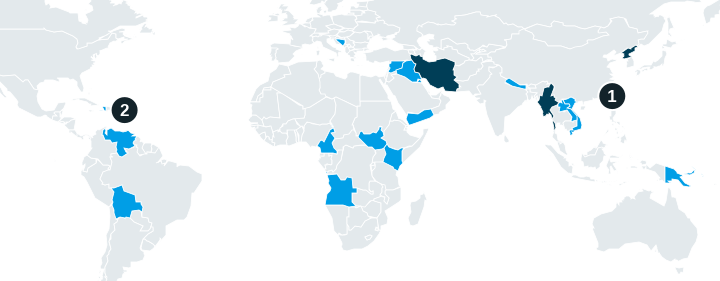
The lists after the October 2026 plenary. Grey-listed jurisdictions are shown in the main colour: Angola, Bolivia, Bosnia and Herzegovina, Cameroon, Haiti, Iraq, Kenya, Kuwait, Laos, Lebanon, Nepal, Papua New Guinea, South Sudan, Syria, Venezuela, Vietnam, Yemen, and the British Virgin Islands, marked ② because they are too small to see. Black-listed jurisdictions are shown in the most prominent colour: North Korea, Iran and Myanmar. ① is Taiwan.
For civil society groups, transfers of donations or humanitarian funds to listed places (such as Myanmar, Lebanon, Syria, Yemen, Haiti and South Sudan) face enhanced scrutiny from banks. That can mean requests for more documents, or the transfer being returned. Since Recommendation 8 was revised in 2023, countries are expected to identify the non-profits actually at risk instead of applying measures to the whole sector. Whether the change reaches banks' day-to-day checks depends on the new round of evaluations. Until then, preparing clear explanations of what the funds are for and who receives them, and choosing auditable channels, is the safer approach.
For individuals, banks and exchanges follow FATF recommendations to know their customers and keep records. Now that the Travel Rule reaches virtual assets, sending cryptocurrency also means attaching the recipient's details, which narrows the room for financial privacy. The FATF aims for full implementation of the Travel Rule by 2030. A later article will cover how these rules land in Taiwan's Virtual Asset Service Act and exchange practice, and where that leaves self-hosted wallets. For background on why anonymous payments matter, see Why anonymous payments matter on our docs site.
Timeline
FATF rules have widened from money laundering to terrorist financing, proliferation financing, virtual assets and payment transparency, and Taiwan's evaluation and the revision won by civil society happened along the way.
- 1989The FATF is foundedSet up at the G7 summit in Paris to develop measures against money laundering
- 1990The first 40 RecommendationsAimed at money laundering
- 2001Terrorist financing addedSpecial recommendations issued after 9/11
- 2012The 40 Recommendations revisedThe special recommendations folded in, with proliferation financing added
- 2018-02Nine jurisdictions on the grey listWhere this page's grey-list data begins
- 2019-06Virtual assets brought under the standardsRecommendation 15 amended in October 2018 and its interpretive note adopted in June 2019, extending the Travel Rule to VASPs
- 2019-08Taiwan's mutual evaluation report adoptedAfter the APG's on-site visit in November 2018; seven effectiveness outcomes rated substantial, and Taiwan placed in regular follow-up
- 2020-06Reviews paused for COVID-19The February 2020 lists stayed in force
- 2021Project on unintended consequencesThe same year, Coin Center's comments on the draft virtual asset guidance stated that applying the Travel Rule to self-hosted wallets is incompatible with privacy rights
- 2022-10Myanmar moves to the black listThe only escalation from the grey list since 2018
- 2023-02Russia suspendedStill on the list of members
- 2023-06Grey list peaks at 26The highest point since 2018
- 2023-10Indonesia becomes the 40th memberThe same plenary adopts the revision of Recommendation 8
- 2023-11Recommendation 8 revision publishedCountries first identify the non-profits actually at risk instead of covering the whole sector
- 2025-10Four African countries leave the grey listSouth Africa, Nigeria, Mozambique and Burkina Faso
- 2026-06Consultation on new Recommendation 16 guidancePayment transparency requirements keep widening
- 2026-1018 on the grey list, 3 on the black listWhere this page's data ends; the black list is North Korea, Iran and Myanmar
- 2030Target for full Travel Rule implementationThe deadline the FATF has set for Recommendation 16
For how Taiwan's anti-money laundering regime changed after the 2016 case against Mega Bank's New York branch, see Taiwan's anti-money laundering regime, origins and current supervision. The 2030 Travel Rule deadline, the next date that bears most directly on payment privacy, is left to a later article.
About the data
- Grey list: 27 plenaries from February 2018 to October 2026, compiled from the FATF statements republished by Taiwan's Investigation Bureau, US FinCEN notices and New Zealand's Department of Internal Affairs, with each list checked against the one before
- Income groups: the World Bank's historical income classification (via Our World in Data), using the classification in force on each plenary date, counted by jurisdiction without weighting by population or economic size
- Effectiveness ratings: the FATF's consolidated assessment ratings (2013 methodology, updated 3 November 2026), using the latest report for each jurisdiction
- The data files are on GitHub
Further reading
- Anonymous payments research track
- Taiwan's 2026 Virtual Asset Service Act
- Why anonymous payments matter
- Translated reports and guidance
Sources
- FATF: Consolidated assessment ratings, Mitigating Unintended Consequences, R.16 public consultation (June 2026)
- APG: Chinese Taipei mutual evaluation report, 2019
- Kida and Paetzold, The Impact of Gray-Listing on Capital Flows, IMF WP/21/153, 2021
- Ronald F. Pol, Anti-money laundering: The world's least effective policy experiment? Together, we can fix it, Policy Design and Practice, 2020
- Julia Morse, Blacklists, Market Enforcement, and the Global Regime to Combat Terrorist Financing, International Organization, 2019
- Devin Case-Ruchala and Mark Nance, FATF blacklists don't work the way you think they do, working paper, 2020
- RUSI: The FATF Gains Momentum in Breaking Africa's Cycle of Grey Listing, FATF's Recommendation 8: A Cure Worse Than the Disease
- U4: The participation of low and middle income countries in the Financial Action Task Force
- Basel Institute on Governance: FATF grey list: truth and myths
- FATF: Jurisdictions under Increased Monitoring, October 2025 (as republished by the Investigation Bureau), outcomes of the October 2023 plenary
- Laws & Regulations Database (in Chinese): AML/CFT regulations for virtual asset service providers (Article 7, amended 20 October 2026)
- Central News Agency: new rules for domestic crypto transfers take effect in October (4 August 2026, in Chinese)
- FATF: revision of Recommendation 16 (June 2025)
- Financial Supervisory Commission, Insurance Bureau: letter forwarding the Investigation Bureau's notice on the FATF lists (14 July 2025, in Chinese), with the Bureau's letter of 19 June 2025
- Global NPO Coalition on FATF: Plenary approves revision of Recommendation 8
- Coin Center: Comments on the FATF's draft virtual asset guidance
- World Bank: Country and Lending Groups, via Our World in Data