Setting Up a Tor Relay at National Taiwan Normal University: A Practical Experience of Communicating with the University and Leaving Open Possibilities
Preface: Why Talk About Anonymous Networks on Campus?
In an era where the internet is highly monitored and centrally managed, anonymous communication is no longer merely a technical option—it is a fundamental requirement for safe exploration, research, and expression. For Taiwan, this issue is especially tangible. Situated at a critical position in East Asia, internet freedom and communication resilience are no longer abstract values, but core societal capabilities that determine whether society can withstand pressure.
Universities and academic networks have historically been the earliest places where new technologies and public infrastructure are experimented with. The following interview documents how a computer science student at National Taiwan Normal University, also a member of the anonymous network community, stepped into institutional reality on campus, communicated with the university, and attempted to actually set up a Tor Relay.
Within the anonymous network community, we often talk about technology and ideals. But what is truly difficult is often not how to configure a Tor Relay, but whether “this machine can survive in the real world.”
This time, we interviewed a partner from the anonymous network community, NZ, who is currently studying in the Department of Computer Science at National Taiwan Normal University. He successfully set up a Tor Relay on campus—and not by doing it secretly, but by choosing to engage openly with the university system and completing the full administrative process.

蘇恩立 (Su En-Li, NZ) is currently a third-year undergraduate student in the Department of Computer Science and Information Engineering at National Taiwan Normal University. With a strong interest in information security and network governance, he is currently responsible for operating and maintaining the first Tor node on Taiwan Academic Network (TANet). In addition to hands-on technical practice, he is also dedicated to knowledge sharing, serving as an anonymous network course instructor in the GDGoC NTNU student club. He has long been involved in Taiwan’s open source and information security communities, and has volunteered multiple times at major technical conferences such as SITCON, HITCON, and COSCUP, demonstrating both community service experience and strong technical passion.
Why Set Up a Tor Relay at a University?
His motivation was actually quite simple: if anonymous networks in Taiwan only ever exist within niche communities, on overseas VPSs, or are treated as tools in a legal or moral gray area, then they are unlikely to be taken seriously. Universities—especially academic networks like TANet—are inherently meant to support research, experimentation, and public interest. In theory, they should be able to accommodate attempts to deploy this kind of foundational infrastructure.
That said, he was also fully aware of the real-world constraints. Taiwan’s academic network is highly centralized, with outbound connectivity controlled by the Ministry of Education. Within such a structure, anonymous networks are inherently constrained and unable to realize their full potential.
But precisely because of these limitations, he wanted to find out: “Under such constraints, can it at least exist?”
How Did He Talk to the University? The Key Wasn’t Persuasion, but Giving Them Something They Could Account For
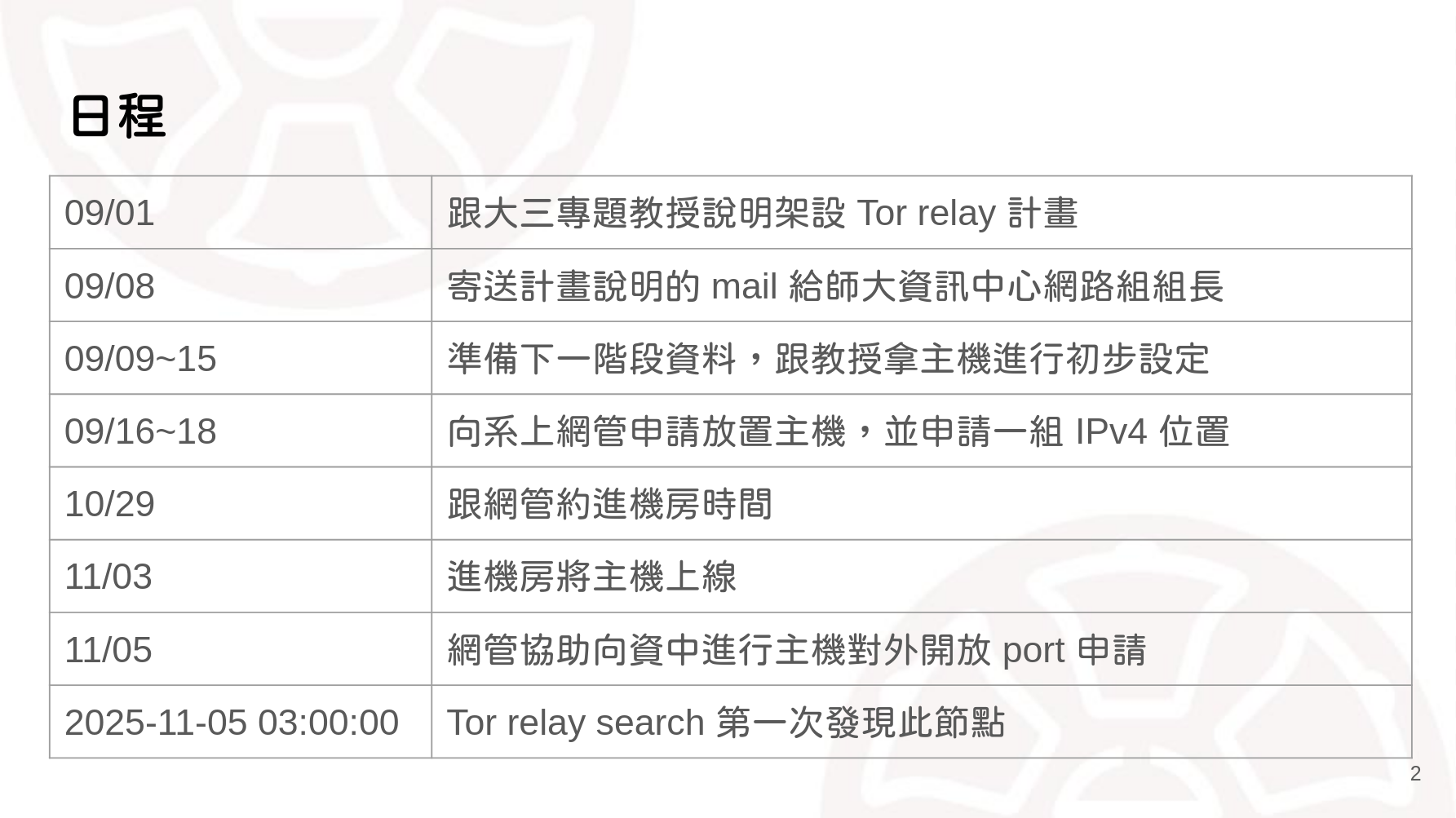
When it came to taking action, he didn’t package Tor as something “cool” or radical. Instead, he explained it in terms the university could understand:
- This is a Tor Relay, not an Exit Node
- It does not directly provide content to external users
- It is an experiment in network infrastructure and anonymous communication
Process-wise, he engaged in actual email exchanges with network administrators, professors, and the department chair, ensuring that everyone who needed to sign off—or be “CC’d”—understood exactly what this machine was doing. The university’s stance was not “we fully understand Tor,” but rather, “if the Ministry of Education asks us about this, we need to be able to explain it.” And that, precisely, became the entry point for communication.
The Administrative Process Is Truly a Hassle, but Not a Dead End
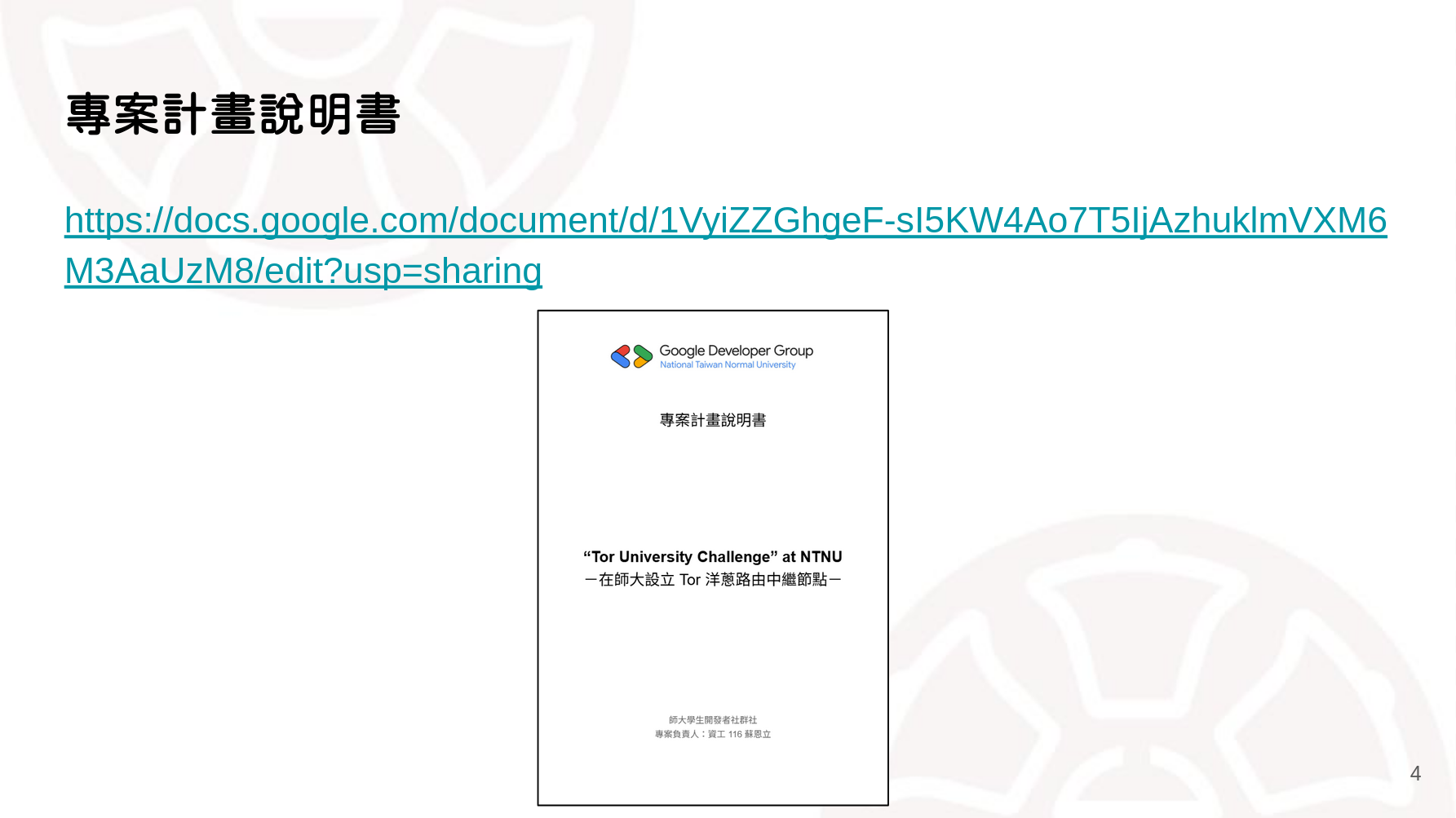
At National Taiwan Normal University, all outbound connections are blocked by default. Any service requires applying for an exception, including specifying IP addresses, intended use, and supporting documentation, and ultimately ensuring it aligns with the university’s reporting procedures to the Ministry of Education. He described this process as “annoying, but predictable.”
As long as one is willing to write the paperwork and explain things clearly, this path does exist.
Student Organizations and Outreach: At Least Let Tor Be More Than Just a Label
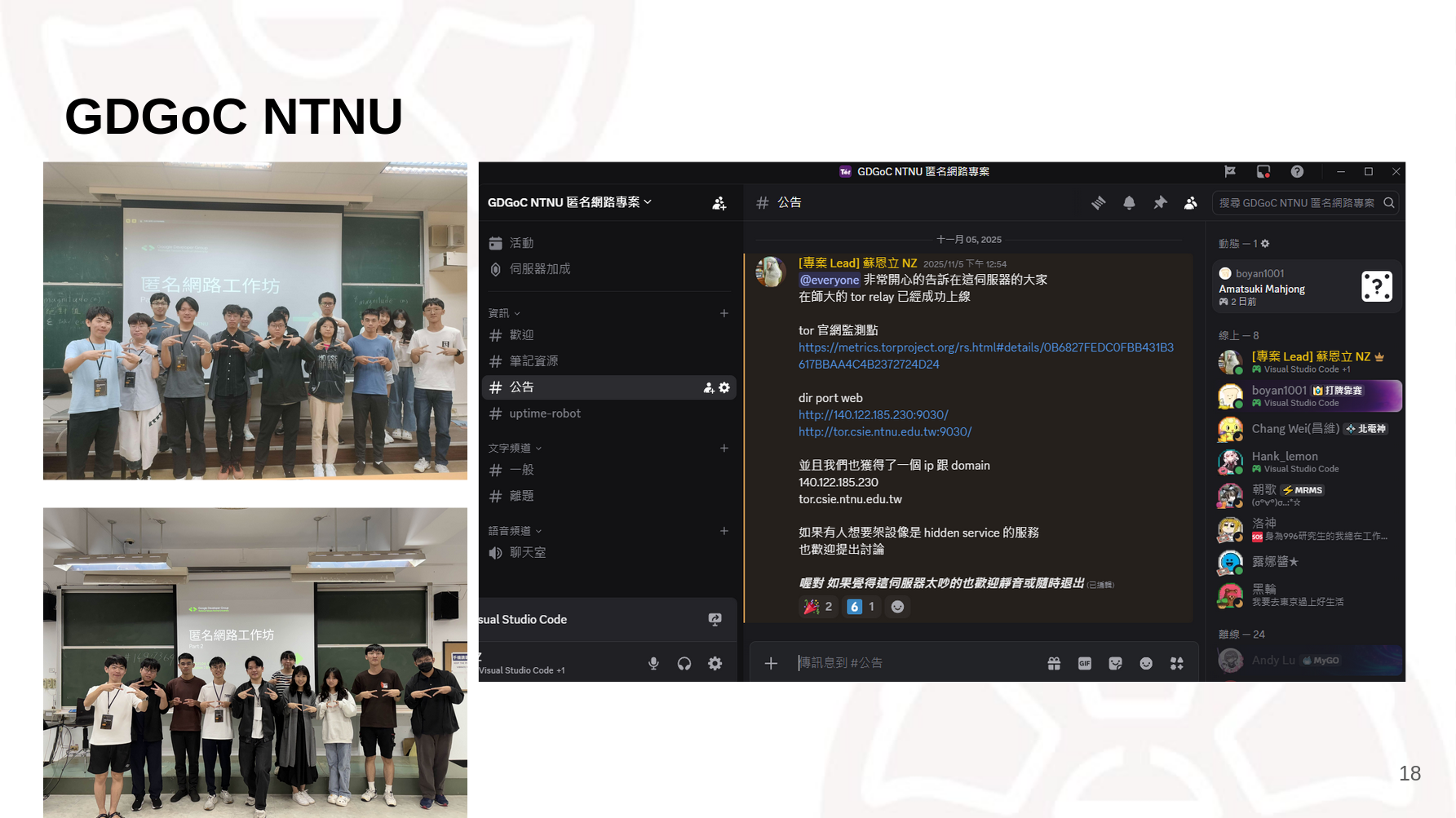
Beyond the machine itself, he also organized anonymous network–related activities through student clubs on campus, introducing Tor, anonymous communication, and the design principles behind them. Even if participation wasn’t always large, it at least created space on campus to clearly explain that “anonymous networks ≠ criminal tools,” rather than leaving the topic trapped in stereotypes alone.
These accumulated efforts may not be highly visible, but they are important.
Practical Advice and Pitfalls for Others
The following points are distilled from this experience, intended as a reference for anyone who wants to promote or deploy a Tor Relay on a university campus in the future.
Actionable Advice
- Take the public route from the start: don’t wait until something goes wrong to explain—let network administrators and supervising professors know what you are doing early on.
- Clearly distinguish between a Tor Relay and an Exit Node: this is almost always the deciding factor in whether communication succeeds, so be explicit about the difference in risk.
- Explain things in a way the university can “account for”: the goal is not to persuade faculty to support anonymous networks ideologically, but to ensure they can answer questions when asked.
- Expect a lot of paperwork: IP addresses, outbound connectivity, and usage descriptions are all basic requirements.
Common Pitfalls
- Assuming technical correctness is enough: within academic networks, institutional processes often determine success or failure before technology does.
- Underestimating the Ministry of Education’s level of control: most universities block outbound connections by default, and any exceptions must align with formal reporting procedures.
- Failing to plan for maintenance and account ownership: account privileges after graduation directly affect whether long-term operation is possible.
Conclusion
This attempt to deploy a Tor Relay at National Taiwan Normal University is neither an endpoint nor a definitive answer. But it does prove at least one thing:
- Within Taiwanese universities, as long as one is willing to communicate and explain,
- Anonymous networks are not entirely without a place.
If we hope to see Tor Relays on more campuses in the future, these “uncool but time-consuming” efforts may well be the most important foundation of all.
Further Reflection: Why Are Attempts Like This Worth Preserving?
After reading this interview, it is easy to focus on “what he accomplished.” But for the anonymous network community, what matters even more is how this was accomplished.
In Taiwan, anonymous networks do not lack technical documentation or ideological support. What is truly scarce are experiences of “having walked through the real institutional system once.” Especially in an environment where academic networks are highly centralized and outbound connectivity is tightly controlled, distributed anonymous infrastructure like Tor Relays is inherently difficult to sustain.
This implementation at National Taiwan Normal University was not meant to provide a final answer for anonymous networks, but rather to be a concrete attempt made within real-world institutions. It may not immediately improve the performance or security of anonymous networks, nor was it intended to become a directly reproducible standard process. What it did achieve, however, was leaving behind a clearly visible path of practice—one that can be understood, referenced, and built upon.
This path shows us that:
- Anonymous networks do not necessarily have to operate only overseas, underground, or in legal gray areas
- Campuses are not places that can only reject such efforts; they need to be properly informed
- Administrative procedures may be cumbersome, but they are not entirely impossible
- Beyond technology, language, patience, and institutional understanding are equally important
For Taiwan, the advancement of anonymous networks is unlikely to begin with a “killer application.” Instead, it will likely emerge from the accumulation of these seemingly slow, tedious, and even somewhat clumsy attempts.
If, in the future, we hope to see Tor Relays or other anonymous communication infrastructure across more universities and academic network nodes, then these early experiences—whether successful or obstructed—are all worth recording, discussing, and passing on.
The existence of anonymous networks is not the result of isolated individual actions, but the outcome of communities engaging in long-term communication, mutual understanding, and collaboration. Through such processes, internet freedom can move from an abstract concept to a public infrastructure that can truly be put into practice.
Tor × EFF University Challenge: Make Your Campus Part of the Anonymous Network
The Tor Project and the Electronic Frontier Foundation (EFF) jointly run the Tor University Challenge, inviting university students around the world to set up Tor Relays on their campuses using academic networks. By successfully deploying and maintaining a Tor Relay within a university network, participating institutions can have their university names listed on the project’s official website—showing the world that their campus is actively contributing to the infrastructure of anonymous communication and internet freedom.
This is not only a technical challenge, but also a symbolic act: it represents a university’s willingness to support the practice of privacy, anonymity, and an open internet within the realms of education and research. In the National Taiwan Normal University case discussed here, we have already seen that as long as there is a willingness to communicate and understand institutional constraints, Tor Relays are not impossible on Taiwanese campuses.
If you are currently a university student with an interest in networking, cybersecurity, privacy, or public infrastructure, the Tor University Challenge offers a concrete and documentable starting point: let your actions take place not only on your own computer, but also be seen by the world.
 Project website: https://toruniversity.eff.org
The Role of Tor Relays in Academic Networks
Many people have heard of Tor, but do not necessarily understand its significance within academic networks.
What Is a Tor Relay?
Tor is an anonymous communication network that routes traffic through multiple nodes using layered encryption. A Tor Relay (middle relay) helps forward encrypted traffic and, by design, cannot see either the user’s source or the final destination.
It is not a content-providing server, nor is it an exit node.
Why Are Academic Networks Suitable for Discussing Tor Relays?
- Academic networks are inherently meant to support experimentation
- Universities carry public responsibility and research legitimacy
- Experience can be accumulated in a controlled environment, rather than relying solely on overseas resources
At the same time, Taiwan’s academic network is highly centralized and externally controlled, which makes Tor’s presence here more like a “compressed experiment.”
Why Is It Still Worth Doing Even If the Impact Is Limited?
Because the goal is not purely performance, but rather to:
- Leave behind an institutionally “viable path”
- Accumulate experience in communicating with universities
- Bring anonymous networks into public discussion, instead of keeping them as underground technologies